Wednesday, July 22, 2015

A place on the table

(If you received this blog by email, you might want to visit the actual site. The pictures work much better there. 
Just click on the title, “A place on the table”)


This summer, I’ve been on a serious return-to-fitness kick, trying to regroup from the long spell of inactivity brought on by last fall’s assorted orthopedic woes. I’ve been really conscientious about it, too, prioritizing walks and workouts and such rather than letting them take the last, left-over spots (if any) in my schedule. So today, after a nice lunch with a friend in Golden and before I got back to work, I planned to stop on my way home for a walk, thinking I’d probably do a loop on a local trail and call it good. But just north of Golden, I spotted the trail head for the North Mesa Trail. I’d never hiked it before (though I'd heard tales), and the steep initial climb really beckoned. So I traded lunch duds for walking shorts, slathered on sunscreen, and started climbing.


If you live in the Denver area and haven’t yet explored this trail (or rather, this web of trails), check it out. It does start with a serious uphill grade, but the almost immediate reward is great views to the west—that wonderful Colorado sky and the shadows of the clouds on the hills. But maybe the best treat for me was the pleasure of walking up a steep hill, settling into a steady-state pace, and discovering that my “training” has actually worked. If legs and lungs can smile, then mine were smiling. But I suspect my fitness regime is of far less interest than the scenery, so I’ll skip right to the nature tales and pictures.

From the road, North Table Mesa looks dry, rocky, and boring. But in truth, once you get up the hill and on top of the mesa, it’s really lovely. At least this year, with our ample rain, the meadows are soft and beautiful, and even mid-summer, the wildflowers and grasses are really nice. 


From the flat mesa top, you can see east to Denver and west to the afternoon clouds rolling in.


Around a bend in the trail, I was surprised to see a large-ish pond (in Colorado, we might call this a lake)—thanks, I suspect, to the abundant rain, since there are definitely no streams up there. 


I heard and saw lots of birds—meadowlarks, swallows, circling hawks, an American kestrel on a wire, a cormorant landing on the pond, and a bumblebee big enough to count as a small bird. 


And at the top of the highest promontory, the increasingly common rusty-legged signal carrier.


This unexpected adventure was such a treat—a trail I hadn’t walked, a beautiful day, and the sweet awareness that walking uphill is actually fun again. What a great day.


© Janis Bohan, 2010-2015. Use of this content is welcome with attribution and a link to the post. 

-----------------------------------------------------------------

Comment on this post:  

If you got this blog via email, go to the blog website by clicking on the title at the top of this particular post.

To comment once you're on the website, click on "No comments" (or "2 comments" etc.) below the blog. Comments from "anonymous" welcome.


Tuesday, July 14, 2015

Witnessing Pluto


I was barely awake this morning when I thought about Pluto. I’ve been following the approach of the New Horizons spacecraft as it nears the “Pluto system” (Pluto and its five known moons), about 3 billion miles and more than 9 years after its launch. The thoroughly amateur astronomer in me was eager to learn the status of the mission, and I knew that the moment of its closest approach would be early this morning. That would be at 7:49 EDT, I recalled … translating that to 9:49 MDT. A bit later, a news alert on my partner’s phone declared that New Horizons had reached Pluto—at 5:49 MST, of course.

I had this instantaneous moment of deep disappointment: “Rats,” I thought (maybe out loud). “I wanted to notice that moment. I wanted to witness it.”

Pretty quickly, I realized that I was awake at the crucial moment. I had even noted the time at 5:45, and I was thinking about Pluto. That made me feel better, but I could still hardly wait to get to my computer to learn more—and I made a mental note not to miss the moment when, at about 8:53 EDT tonight (note to self: that would be 6:53 MST), New Horizons should send a brief signal indicating that it made it safely through the Pluto system. 

All day, as I monitored news about the encounter with one eye, I was also being curious about my early-morning reaction, my peculiar attachment to this event. It’s hardly central to my life, although it's obviously a matter of great interest. Why did it matter whether or not I was awake to witness that moment?

I wasn't wondering about the intensity of my interest in things astronomical. That’s a near-lifelong passion that has waxed and waned over the years but has never been absent. And I wasn’t wondering about my astonishment at the sheer magnitude and precision of the knowledge required to pull off such a feat—with now-old technology, with a target that had never even been seen clearly, a spaceship launched almost 10 years ago toward an impossibly remote and tiny moving object (smaller than our moon). (If you want to get a hint of the mind-blowing precision of this shot, described by one scientist as equivalent to hitting a hole in one with a golf shot that travels from New York to LA, check out this graphic). That’s definitely astonishing enough to warrant some serious interest, not hard to explain at all.

Besides, there are plenty of things to make this an especially noteworthy happening for me: the lead instigator and investigator for the project is at the Southwest Research Institute in Boulder, and bunches of CU students have worked on the project over the years. And then there’s Pluto’s mythical status—the planet (OK, dwarf planet) so small and far away that even Hubble can’t get a clear picture of it, the planet that was named by a child and that soon became the namesake of Mickey Mouse’s dog. How could I not feel some attachment to Pluto? (OK, so lots of people don’t … but it makes sense for me.)

But none of that is curious at all. No, the question that puzzled was this: Why was it so important to me that I be conscious of that precise moment when the spacecraft arrived at Pluto? That I “witness” it?

That question was in the back of my mind through the day as I hovered in the news and did my day's work. I kept returning to this answer: I think that, at least in part, it’s about age. In that moment, as in many these days, I was acutely aware that singular events won’t be happening indefinitely for me. And I don’t want to miss them as they come along. Pluto provided an occasion for me to look (again) at that part of my aging experience: missing things matters more to me. Even missing apparently unimportant things like the Pluto flyby.

In recent years, I’ve noticed a certain nostalgia, even regret, that has to do with experiences that passed without my paying (enough) attention. I actually wrote about this here a long time ago, and it keeps happening. For instance, I might recall a place I visited, a hike I took, a forest or a sunset I saw, a time with a friend, a physical challenge met—so many things that I know I experienced but that I don’t feel like I really noticed, actually witnessed. In retrospect, I find myself wishing that I had known it would be my last time being there, doing that, whatever it was, so I could have honored it more. Pluto’s very rare moment was reminiscent of those now rather frequent moments.

As I think about it, I believe I have a tendency to not notice experiences as they pass by—an unfortunate penchant under any circumstances, but especially lamentable as I grow old, when the opportunities to do it again, whatever it might be, are increasingly rare. It's good to have my attention drawn to this issue, even if it takes a (dwarf) planet to do it.

Coincidentally, this morning a friend, with whom I’ve talked about this general theme, sent me this cartoon that describes the feeling well.  


I know that New Horizons’ encounter with Pluto is not a life-changing event (for me) and that it may even seem trivial as an example to make this larger  point. But that’s part of the point—how seemingly “trivial” moments can carry a certain magic, if they matter (for whatever reason) and if we take the time to witness them. I think that’s where my momentary regret came from this morning: it mattered to me, and I feared I’d missed it. I don’t want to do that too often, because I don’t want too many regrets about missed singular experiences. Obviously, there will be many, far more important such moments. I’m grateful to Pluto for this reminder to notice them, however trivial or singular.

As for the New Horizons flyby, I had my phone set to signal me at 6:53 MDT this evening so I could check on the spacecraft's well-being. Just after 7:00, I saw a news flash that New Horizons had “called home,” right on schedule.

I’ll keep following it in the days to come. If you’re in the Boulder area and would like to join in that process, Fiske Planetarium on the CU campus will be hosting a couple of public events later this week where you can learn more—and also see some of the pictures being sent back across billions of miles.

I’ll be there, on time, MDT.


© Janis Bohan, 2010-2015. Use of this content is welcome with attribution and a link to the post. 

-----------------------------------------------------------------

Comment on this post: 

If you got this blog via email, go to the blog website by clicking on the title at the top of this particular post.

To comment here on the website, click on "No comments" (or "2 comments" etc.) below. Comments from "anonymous" welcome.


Thursday, July 9, 2015

Before marriage (equality) was imagined

If you received this blog by email, you might want to visit the actual site. The pictures work much better there. 
Just click on the title “Before marriage (equality)….” 

Last week’s US Supreme Court ruling declaring that marriage is a fundamental right and that barring same-sex couples from access to that right is unconstitutional unleashed torrents of joy and commentary that have only now, almost two weeks later, started to ebb. Some folks have bemoaned how long it took us to get to this point. Personally, I’m astonished at how quickly it happened, especially relative to other social justice movements. In a single lifetime, my lifetime—in fact, in what I call my “conscious lifetime,” i.e., the period since adolescence—the status of LGBT folks has shifted from our being regarded as illegal, immoral, and insane to our achieving constitutionally sanctioned participation in what is historically the most revered heterosexual institution of our society. How amazing to have been present for all of that—and even engaged in some parts of it.


Just days after that ruling, we took a long-planned trip to Philadelphia, where we joined in celebrating the 50th anniversary of the birth of the gay rights movement. Now, the modern queer rights movement is usually dated from the Stonewall uprising, that iconic moment when a group of LGBT folks refused to be herded into a police paddy wagon outside a Mafia-owned bar in NYC. That event, now commemorated around the country by Pride parades and festivals, happened in the early morning hours of June 28, 1969, some 46 years ago. So why was this celebration on July 4 in Philly—wrong day, wrong year, wrong city—billed as the 50th anniversary of the LGBT rights movement?

It's all about the parts of history we don't usually hear. Here's the story, for folks who don’t know it, followed by glimpses of this great three-day celebration.

The contemporary LGBT movement in the US actually began in the 1950s, though it was known in those days as the “homophile” movement (the word means, roughly, “affection for the same”). The primary focus of that movement was on freedom from discrimination, especially in the workplace, and freedom from police harassment.

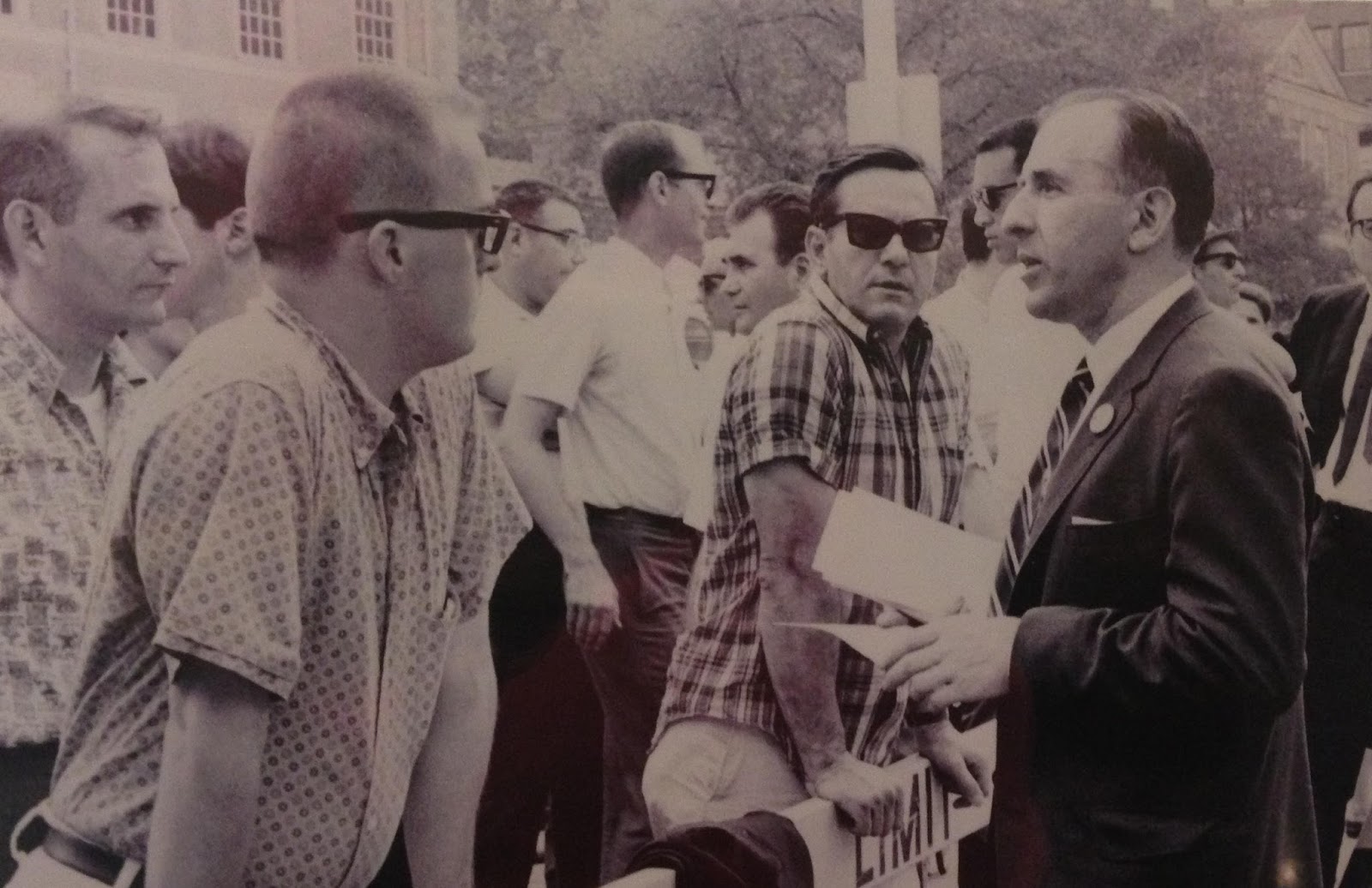
The event we celebrated in Philadelphia this past week, which preceded Stonewall by four years, was a carefully coordinated series of pickets (a tactic borrowed from the African-American Civil Rights movement) carried out by members of this homophile movement. These gay and lesbian picketers chose Philadelphia because it’s home to the Declaration of Independence, the Constitution, and perhaps most importantly, the Liberty Bell. Other folks organizing for their rights—notably, the abolitionist movement and the suffrage movement—had also employed the symbolism of that bell. In each case, the argument was that the nation was not living up to the promise of the founding documents or of the caption inscribed on the Liberty Bell, “Proclaim Liberty Throughout All the Land Unto All the Inhabitants thereof.”

   
Barbara Gittings,
a key organizer of the Reminder Days,
walking the picket line.
In 1965, identifying as “homosexual” (the term widely used at the time by LGBT folks as well as their detractors) could easily land someone in jail or a mental institution, could mean medical “treatments,” the loss of your job, your housing, and your relationships with family and friends. Yet in that atmosphere, 40 brave folks chose to picket in front of Independence Hall in Philadelphia. The demonstrations began on July 4, 1965, and continued annually through 1969. The activists called these “Reminder Days”—reminders that a group of citizens were still excluded from equal rights. The last Reminder Day, which happened in 1969, just days after the Stonewall uprising, had about 150 picketers. Then, recognizing that Stonewall could be (to quote a speaker from last week’s event) the Boston Tea Party of the LGBT movement, the organizers turned their skills to planning the first ever Pride parade in NYC for the year after Stonewall. And with that commemorative march, the tradition of annual Pride celebrations and, as legend has it, the contemporary gay rights movement were born.

It's not a stretch to say that these daring Reminder Days helped build the momentum that would launch the modern movement, provided the fuel that Stonewall then ignited. So why don't we hear more about these folks and their persistent picketing? Good question, to which I have no definitive answer. But here are some thoughts.

Frank Kameny, the other main organizer,
talks with onlookers
First, the early homophile movement has often been criticized as too assimilationist, dismissed for being so willing to tolerate persistent homophobia, so limited in its aims, so eager to accept tolerance as an acceptable goal. Some of these early activists didn't even question the then-dominant notion that homosexuality was a mental illness—they just thought that this shouldn’t matter as long as the condition did interfere with a person’s ability to function on the job or in the world. One indication of their conservative bent was seen in the strict dress code required of people in the picket lines—men wore suits and ties, women wore dresses, heels, and pantyhose. The goal was to look “normal” and employable, in keeping with the aims of that early incarnation of the movement. But from the perspective of later years and a more ambitious agenda, their stance has been regarded as regressive at best and drenched in internalized homophobia at worst.

Which brings us to a related reason for the relative invisibility of this launching moment: by 1969, the year of Stonewall, picketing, which was initially regarded as a radical and risky undertaking, was no longer viewed as radical enough. This was the era when the student movement, the anti-war movement, the feminist movement, and others were in full, flowery swing. People were rioting in the streets, taking over campus buildings, burning draft cards, turning on and dropping out, clashing with police in hand to hand battle. In the midst of that sort of energy, the Stonewall rebellion probably looked far more like a happening worthy of consideration as the origin of this vibrant social change movement than orderly pickets in front of Constitution Hall ever could be. Interestingly, during the 1969 picket, some marchers already began violating the dress and behavior codes, wearing more casual clothing and even holding hands —a clear sign, if anyone were looking for one, that the movement was morphing. Whatever the reason, Stonewall quickly became the moment of the movement’s mythical birth, and the Reminder Days were largely forgotten.

For the two of us, both LGBT history buffs, this trip was a total treat, a chance to immerse ourselves for a few days in the events of 1965–1969, a pleasure magnified by the Supreme Court’s recent marriage ruling. The juxtaposition of our simultaneous engagement in these half-century-old events and in this remarkable, singular moment in contemporary history was sort of mind blowing. What an incredible time to be alive! Imagine it: to have been around at the time of those early pickets and to still be around to witness this momentous shift in our place in society. What a gift to be here, in this movement at this moment.

Our time in Philly was a three-day submersion in queer history, community, and celebration—all framed over and over by reminders that we have so much work yet to do. Marriage was a marvelous accomplishment, but it doesn’t solve enduring problems of anti-LGBTQ discrimination in housing and employment. It doesn’t address the pervasive difficulties faced by trans folks, especially trans women of color. It doesn’t address the needs of LGBTQ youth, especially in poor, rural, or conservative areas where LGBTQ identity is far from accepted. It doesn’t address issues related to immigration, doesn’t provide answers to income equality, doesn’t solve problems of second-parent adoption and other parenting concerns. Heck, marriage doesn’t even solve the problems of huge numbers of LGBTQ adults who are, for whatever reason, not joining in that institution.


But let me stop with the lecture and tell you about our marvelous time in Philadelphia. First, it felt surprisingly affirming to realize that the city of Philadelphia was honoring this day as a major historical event. There were 50th anniversary banners hanging all around the Independence National Historical Park (the site of Independence Hall, the Constitution Center, Congress Hall, the Liberty Bell Center, etc.), and the museums that participated had created impressive, curated exhibits about it. It wasn’t just a token acknowledgement of the date, but a full-blown city-sponsored occasion. Against this very validating background, we spent our time dwelling in the historic, the celebratory, and the challenging.


The "Gay Pioneers" marker with
Independence Hall in the background.
We began our adventure with a visit to a marker installed by the city of Philadelphia honoring these so-called Gay Pioneers, where we caught a glimpse of James Obergefell, the lead plaintiff in the marriage case (and thereby the benefactor of these early activists’ daring). From there, we moved on to a packed itinerary of museums, discussions, films, and panels, with meals grabbed on the run and an inadvertent tour of much of downtown Philadelphia. We heard panels on legal issues, on legislative issues, on historical perspectives, saw a film about “Gay Pioneers” and one about Black LGBTQ identities, attended an interfaith service led by Bishop Gene Robinson at historic Christ Church (where we sat in the pew that had been reserved for George and Martha Washington and John Adams), and were treated to lively audience discussions that pointed to everything from the roots of the LGBT movement in other movements to the sexism of (even) the queer movement—although that last notion was rejected by the event’s organizer. Between schedule events, we wandered among sponsoring museums and institutions—the Museum of African-American History, the Museum of American Jewish History (which has started a Tumblr site to collect LGBT oral histories), Liberty Bell Center, and the Museum of We the People at the National Constitution Center—all of which had major special exhibits honoring this 50th anniversary.

I learned so much ... new facts and also new perspectives on things I knew. But rather than dwell on all that, let me share some of the mood of these excellent days through a few photos. 


Three of the original picketers
The Liberty Bell Center's silhouette depiction
of the Reminder Days
(complete with Barbara Gittings' sunglasses)


The National Museum of American Jewish History
offered congratulations outside ...

... and exhibits related to Jewish queer experience inside


The African-American History Museum
featured Gerard Gaskin's photographic study of the
house ballroom culture ... 
... a celebration of Black and Latino
urban queer life that provided a safe space
and a support system for queer people of color.


A pixellated Bishop Gene Robinson
led an interfaith service ...


... at historic Christ Church, where many "founding fathers" worshiped.
Out lesbian entertainer Wanda Sykes
served as m.c. for the final ceremony ...


... where a break in the rain and some rousing music
inspired a bit of flag waving, both queer and patriotic


All in all, it was a good weekend. A good Reminder.


© Janis Bohan, 2010-2015. Use of this content is welcome with attribution and a link to the post. 

-----------------------------------------------------------------

Comment on this post:  

If you got this blog via email, go to the blog website by clicking on the title at the top of this particular post.

To comment here on the website, click on "No comments" (or "2 comments" etc.) below. Comments from "anonymous" welcome.


Thursday, June 25, 2015

Time thoughts


The other day, I was walking along thinking about some events from earlier in my life—maybe 20 years ago—and I realized that I had a totally different take on these happenings than I’d had back then. “What a difference time makes,” I thought to myself. That, in turn, brought to mind several recent encounters with the phrase “the tincture of time,” and I was off on a tangent pondering how time changes reality.

Of course we all know that time itself changes drastically as we age. At this point in my life, it seems to rush by—and not just when I’m having fun, either. I’ve actually written here before about some of the explanations that folks have offered for that phenomenon—the way time speeds up as we age. So I won’t dwell on it again (but if you’re curious, just click here  for a trip back in time to that blog). Instead, I want to talk about time, not as a changing phenomenon but as a change agent—something that actually does things to the world as we know it. Which is to say, it does things to our worlds.

It all started when the phrase “tincture of time” came to mind. But I knew that the transformation in my view of those earlier experiences wasn’t about time acting as a tincture. It wasn’t healing old wounds. This was more about time acting as a lens. Pretty soon, I was pondering on several phrases that point to how time changes reality:

The tincture of time. An old saw. I’m not sure whether time heals all wounds (as many of us have likely been told), but I’ve lately been learning that patience and forbearance—i.e., time—ease the sting of many of them. It’s a valuable lesson that not only makes painful experiences feel less totally devastating but also keeps me from exacerbating problems that are better left to settle. When things really aren’t, on second thought, a big deal, often settle if I don’t stir them around like a pot of smelly stew. The tincture of time. Or, as Lennon and McCartney famously urged, let it be.

The lens of time. This one fits the experience that started my ruminations. For some reason, I discovered myself viewing old experiences through a new lens. Actions by others that had bothered me back in the day now seemed to have actually been kind and generous—my old view of them now looked like a product of my own self-absorption at the time, a result of a flawed lens. It reminded me, as I reflected on it, of how a camera lens does this. Cameras don’t see the world like our eyes do. Big things recede, small things come into focus, reality is morphed by the properties of the lens—or the properties of time. And the world changes.

The veil of time. Time hides some things and leaves others open to view. Things that seemed so clear at one point slip from memory, and we don’t even recognize their absence. I was talking to a 13-year-old the other day, who wondered whether we had ever visited him in his home state. We had, many times, so I reminded him of several of those. He flat-out didn’t recall most of them. I could attribute this to his young age, but the one thing he did recall was an experience as a 4-year-old when we persuaded some firefighters on a lunch break to show him their truck, up-close and personal. How many of my experiences have slipped from view without my noticing? And what does it do to my understanding of the world and my life—how would my reality change if memory X had vanished rather than memory Y?

Now, the idea the time itself actually shapes reality isn’t an especially novel or startling concept, although I do think it somehow takes on more salience as I age. Probably because time is so different, now, in unforeseen ways. This is the first time, for instance, that I’ve ever been so totally, suddenly aware—to the point of surprise—that time has dramatically reshaped my understanding of a long-ago event. Without any effort on my part and without my even noticing the process, until the new version cropped up, unbidden, as I walked to the gym one morning.

Then I started thinking about all the ways that our language about time also shapes our reality. I once ran into a discussion of this, framed in terms of a personality typology. But separating it from that theoretical framework, just think about how different our encounter with time is when we talk, for instance, about spending time instead of about wasting it. Losing time vs. investing time. Finding time to do something or losing track of time while we’re doing something. So many words … devoting time, preserving time, making time, protecting, using, taking time … and on and on. Each one says something about the meaning of time—as a treasure, a nuisance, a commodity, a barrier, a burden, a creation, an opening.

What difference would it make, I wondered, if I made a conscious effort to use positive words when I think or talk about time. Now that sounds like an interesting experiment.

I don’t know quite where all this is leading, what I’m trying to say to you. I need to spend some time thinking about this. Maybe that’s all this blog is really for—a reminder to pay more attention to time and its place in my life and my language.


© Janis Bohan, 2010-2015. Use of this content is welcome with attribution and a link to the post. 

-----------------------------------------------------------------

Comment on this post:  

If you got this blog via email, go to the blog website by clicking on the title at the top of this particular post.

To comment here on the website, click on "No comments" (or "2 comments" etc.) below. Comments from "anonymous" welcome.


Thursday, June 11, 2015

Yucca rising

(If you received this blog by email, you might want to visit the actual site. The pictures work much better there. 
Just click on the title “Yucca rising.”)

One of my favorite local walks is in an open meadow on a mesa nearby, with views of the front range and a wonderful feeling of openness. It's often windy, but I love that, too. Early summer walks bring a special treat—the opportunity to watch yucca emerge from their scraggly, pointy bases, stretch tall, looking for all the world like huge asparagus stalks, and then blossom into these lovely waxy flowers. The flowers seem so improbable—they look more tropical than high dessert, although the base seems cactus-like, with stiff sharp blade-like leaves. 

So I thought I'd share some pictures of the emergence of this year's yucca crop. The sun wasn't helping me here. Each day I tried this, it was overcast and gray, not like Colorado's storied blue sky and bright sun, which have been uncharacteristically rare this year. But not being at all the patient photographer who waits for hours or days for the perfect light, I just snapped away, eager to tell the yucca's tale.

So here it is, from stubby stalk to waxy bloom (all in meager sunlight).


See why I like this walk?


© Janis Bohan, 2010-2015. Use of this content is welcome with attribution and a link to the post. 

-----------------------------------------------------------------

Comment on this post:  

If you got this blog via email, go to the blog website by clicking on the title at the top of this particular post.

To comment here on the website, click on "No comments" (or "2 comments" etc.) below. Comments from "anonymous" welcome.


Wednesday, June 10, 2015

The flap over Caitlyn


In the past several days since Caitlyn Jenner was featured on the cover and in the pages of Vanity Fair magazine, I’ve read several articles that have claimed a feminist stance in critiquing her “coming out / coming in” process. These pieces are thought provoking, for sure. And they raise points that are core to feminism, past and present, as I understand it (granting that there are as many forms of feminism as there are people claiming the name). On the other hand, they also raise points that are at the very heart of what it means to “transition” from a male to a female identity—or, as some would describe it, to affirm one’s lifelong identity as woman. And also at the heart of what it means to take a trans-positive stance vis-à-vis questions of gender identity and gender expression (i.e., who one is as male or female, and how people choose to present themselves).

This has been a hard blog to write (and its length reflects that difficulty). I’ve hesitated to wade into this morass, both because whatever I say is bound to tick off a few people (and I prefer to make conversation, not war) and because I have no better perspective on the controversy than a lot of other folks who have already weighed in. But a couple of folks have suggested that I write about it. And part of me has been hankering to do just that because it taps into this amazing chaos created by the intersection of gender (complicated enough in its own right) and feminism (ditto). I’ve spent a lot of time with these issues over the years, and the topic has huge meaning for me—hence, this blog.

Fair warning: I don’t have answers, only musings. The key to grappling with these issues and their occasional conflicts, it seems to me, is to settle into living with uncertainty and ambiguity. So be prepared. Here goes.

Part 1. The main feature.

Caitlyn Jenner’s self-presentation in Vanity Fair was, on many levels, stunning. What an extraordinary journey she has had, and what a remarkable moment this was in the burgeoning transgender movement! Besides, no one knew quite what to expect as Bruce bowed out and Caitlyn strode in, and her entry was dramatic. Much of the reaction to the photo spread dealt with how striking her appearance was—made up and gowned, and from what I’ve read (because I haven’t seen the whole issue), photographed in luxurious settings and lovely poses. Initial responses spoke to her beauty and her courage, and social media were all atwitter (so to speak) with the story of another important person publicly claiming a trans identity, adding to the recent swell of such folks.

Part 2. The flap: some “feminist” critiques.

Within a day or two, the critiques began. Among them were pieces challenging the massive praise for Ms. Jenner, her choice of the means by which she would come out, and her description of what it means to be a trans woman. Some of these articles / columns / blogs were largely anti-trans commentaries, and I won’t be commenting on those. Among the others were several whose writers described their stance as “feminist”—a vague enough claim to cover a lot of intellectual territory. These seemed to encompass two major arguments, and I’ll start by describing those, far too briefly. Stick with me for this. You may or may not agree with these points, but I’ll come back for a second look from a more trans-affirmative perspective—with which you also might or might not agree. And then another round attempting to wrap it all up.

The first critique is based on the feminist notion that women have routinely been valued only for their appearance and that they are expected—indeed, carefully and steadily taught—to be attractive rather than active. The argument is that Caitlyn Jenner’s version of becoming a woman reinforces these narrow stereotypes through a photographic essay that presents her as ultra-“feminine,” posed, busty, made up, and air-brushed. This critique was clearly stated in a New York Times column by Rhonda Garelick. The column is titled “The Price of Caitlyn Jenner’s Heroism”—already hinting at the problem—and the third paragraph summarizes her key point: “Caitlyn Jenner’s transition is more than a private matter. It is a commercial spectacle on an enormous scale, revealing some disturbing truths about what we value and admire in women.” Garelick goes on to describe Jenner’s clothing, her hair, her makeup, and her poses as classic expressions of a view of women that values them only insofar as they are beautiful, passive, and on display. She continues: “This seems less the liberation of a true self than a reminder of the straitjacket requirements of acceptable, desirable womanhood.” The closing paragraph underscores the point. Garelick writes, “While the fanfare around the emergence of Caitlyn may advance our acceptance of transgender individuals, it does so, in this case, at a price: the perpetuation, even celebration, of narrow and dehumanizing strictures of womanhood sustained by the fashion and entertainment industries. True liberation of gender’s vast spectrum should ask more of us than that we simply exchange one uncomfortable, oppressive identity for another.”

The second argument is based on the feminist notion that one’s identity as a woman is shaped not by biology, as Jenner has suggested in references to her “female brain,” but by gender-related experiences that begin in the cradle (or before) and end in the grave. The crucial point here is that gender is made, not born. It is not a matter of innate “tendencies” or “brain differences,” but a product of years and years of living within the constraints set for women by society. Thus, the experience of someone who transitions to womanhood in adulthood simply is not, cannot be the same as the experience of being a woman for life.

This position was at the heart of another NYT column by Elinor Burkett titled “What Makes a Woman?” Aghast at the brain argument, Burkett writes, “Suddenly, I find that many of the people I think of as being on my side—people who proudly call themselves progressive and fervently support the human need for self-determination—are buying into the notion that minor differences in male and female brains lead to major forks in the road and that some sort of gendered destiny is encoded in us. [That sort of argument] was used to repress women for centuries. But the desire to support people like Ms. Jenner and their journey toward their truest selves has strangely and unwittingly brought it back.”

To counter this misconstrual, in her view, of what shapes women’s identity, Burkett cites a neuroscientist who explains that the differences between male and female brains are caused not by innate differences but by the “drip, drip, drip” of experience, of the gendered environment. At least from an outside perspective, the drip, drip, drip of Bruce Jenner’s earlier life included decades of the sort of privileged experience that comes to men without their noticing. So however Caitlyn dresses and moves and speaks, whatever roles she assumes, she will never know what it means to have been a girl/woman from birth, to have lived in that one-down position for all those decades. (Burkett disregards the fact that men are also harmed by sexism, but that’s another blog.) In fact, Burkett suggests that trans women’s insistence on being regarded as “real” women threatens the very meaning of “woman.” (This aspect of Burkett’s column has itself received a fair amount of commentary—like this Huffington Post article).
Some of what fuels the position that Burkett represents—with its obvious edge of outrage—is the sense that a challenge to gender binaries was the explicit aim of the feminist movement decades ago, long before trans issues had received notable visibility. That early feminist work, she argues, is why we now see so much less gender discrimination than we saw back then, when the feminist movement was the only gender-binary-smashing game in town. We should be together in this, feminists and the trans movement, she seems to say. But instead, trans activists have missed the boat, retreated to the biological determinism, and abandoned the position that previously brought such dramatic (if still incomplete) change.
Part 3. Some trans-positive responses
OK, those are the two prominent feminist positions I spotted. Now, let me suggest another, more trans-positive perspective. First, let me acknowledge that, not having experienced a disjunction between my physical self (or my assigned gender) and my gender identity, I can speak only from things I’ve read and conversations I’ve had with trans folks. With that fiat, my hope is to present a counterpoint to Garelick’s and Burkett’s arguments from the position of an ally to trans folks and a lesbian who has shared some similar experiences of prejudice, discrimination, and opportunity deriving from non-mainstream identity.
First, let’s consider Caitlyn Jenner’s hyper-feminine (in the traditional sense) self-presentation. I have two thoughts. First, whose business is it how she dresses, uses make up, presents herself in her behavior, poses, mannerisms? Plenty of women who aren’t trans identified are extremely focused on appearing “feminine,” spending fortunes and hours (to paraphrase T. S. Elliott) preparing a face to meet the faces that they meet. The (other) Kardashians come to mind. Now, we may not prefer their choices, might even think them problematic. But other folks might think the same of our manner of self-presentation, and whose business is that?
Second, and on a very different plane, despite the critics' insistence that the Vanity Fair piece portrays a woman preoccupied with abiding by the limiting rules for women’s appearance and behavior, it seems obvious that Jenner's choice to transition was indeed a very self-defining and self-affirming act. It was far from passive. Her choice of physical accoutrements—clothing, hair, make up, mannerisms—could be seen as defiant rather than submissive. This presentation is the epitome of the self-presentation that was denied her when she was living as Bruce. She claims her gender identity with an exclamation point, affirmatively and unapologetically.
As for the challenge to Jenner’s biological claims, we simply don’t know enough about the brain to claim either that trans people’s brains, women’s brains, or men’s brains are unique in some way or that they are not. Personally, I resist a purely biological explanation for virtually any complex experience, but we simply can’t answer this question at this point. Besides, why does it matter?
To the argument that Jenner (and other trans women) fail to recognize the experiences of oppression they’ve escaped by virtue of their late entry into their identity as women, I have two reactions. First, trans women (and other trans people) have, in fact, experienced their own version of oppression, suppression, repression over the years of coming to this point in their lives. And I’m guessing they weren’t immune to sexism. Their awareness of themselves as women could easily have made them acutely sensitive to the sexism they witnessed, knowing it could be directed at them. The bias they’ve faced isn’t the same as the version of oppression that girls and women experience, but who’s to say that it’s less painful—or less valuable. It’s true that trans women have not lived their entire lives as the direct objects of explicit and implicit sexism—indeed, they may have enjoyed male privilege for some part of their lives. And it’s true that they therefore reach adult womanhood with a different perspective on life. So what? Those of us who grew up as women, dealing with sexism for decades, also reached adulthood with unique perspectives. While we can argue that the shared experience of lifelong sexism creates a bond among non-trans women, it needn’t drive a wedge between us and trans women. On the contrary, it could sensitize us all to the consequences of oppression of any sort.
Second, what are we doing here, deciding who is a “real” woman? What are the criteria? Will there by tests? What sort of self-presentation will legitimize my identity as a woman? How long must I have lived as a female for it to “count”? If I’ve been targeted by severe sexism for a while, does that make up for my earlier years? Or is it all about being female at birth? If so, how will we respond to people with intersex conditions? Who among them will count as women? If the feminist movement has taught us anything it’s the danger and the cost of shoving people into narrow identity categories. Do we really want to start our own round of that sort of treatment of others?
Part 4: Is there a “right” answer?
By now, you (like I) may be sufficiently flummoxed by these arguments and counter arguments to be wondering what the “right” answer is. I don’t know. But I’ll share a few of my personal thoughts about it.
First, the matter of Jenner’s (and perhaps other trans people’s) buying into, even exaggerating long-standing gender stereotypes. I think both sides have a point here, and I suspect their intersection offers a deeper message for us. To be honest, the question of whether trans folks might reinforce gender stereotypes (or, if you’re into such debates, may reinforce the gender binary itself) has been a matter of some concern to me. I cut my feminist teeth on the notion that “feminine” was too close to “oppressed” for comfort. Back in the day, shaking off rigid expectations around dress, make up, behaviors, occupational choices, etc. was the heady heart of feminism. We especially worried, as Garelick does, that the traditional image of women, found in the media and in our lives, would unduly influence young girls, presenting as “ideal” a very constricted view of who/how they could be as women. It should not come as big news that this constricted image has not disappeared. Just visit the toy section of your local department store to see the range of choices girls now have: which pink-garbed “princess” doll would you like? I realize that the “pay-off” of this particular form of self-presentation is huge, so the odds are stacked in favor of girls’ opting for an image similar to the one we see in Jenner’s Vanity Fair article. But to lay that at her feet—or the feet of trans women in general, a tiny fraction of women who present themselves in this way—is to ignore the multitude of other images of this ilk that we encounter every day. If the portrayal of women we see in this magazine is something that we need to work on, then let’s work on that instead of criticizing Caitlyn Jenner’s invocation of that widely displayed image.

This leaves two items: the question of whether trans women can rightfully claim identity as “real” women—presumably thereby threatening the integrity of “woman” as an identity category—and frustration at the apparent disregard for early feminist work that challenged binary gender categories decades ago. On a personal level, I admit to having had reactions similar to the authors' in both of these areas over the years. With respect to the first point, my issue was not whether trans women “counted” as women, but whether women who identified as lesbian by choice counted as “real” lesbians. It was only when I began to think of identity not as an essential, predetermined quality but as a product of life experiences, cultural understandings, and lots of contextual factors that I got over it. My conclusion: your claim to a “lesbian” identity is defined by your experience, not mine. I feel the same way about trans women’s identity as women.
And with respect to the second point, I’ve also had moments of distress at a sense that the trans movement doesn’t recognize the legacy of 1970s feminism, which was grounded in precisely the notion that binary gender categories were stultifying and should be challenged at every turn. I have similar moments when I hear young feminists talk about sexism as if it were just discovered. Don’t they know we already figured that out? Don’t they realize how far we’ve come as a result of our work way back then? But some years ago, someone suggested to me that it would make more sense to celebrate the fact that these ideas persist as important cultural themes. Sure it would be nice if we were finished with sexism—and racism, heterosexism, cisgenderism, classism, ageism, ableism, and the rest. But the crucial thing is that we’re still having these conversations, or else none of it could possibly change. I feel the same way about the challenges to gender brought by the trans movement. Sure, I’d like them to acknowledge how 1970s feminism—and later, the LGB movement—helped pave the way for their work. But in my less selfish moments, I’m just glad that we’re still moving, now with them. 
Part 5: The bottom line
IMHO, both the praise for and the critiques of Caitlyn Jenner’s process bear bits of insight and bits of myopia. Both seem right to me, and both seem wrong. Which actually makes total sense. Especially in the middle of such a major cultural shift, how could we not be uncertain and ambivalent.
The trans movement brings us an opportunity—even a responsibility—to examine long-held beliefs about the nature of gender. This is no small undertaking, given that as a culture, we feel so certain that gender is dichotomous and fixed. But the openings for challenging this view abound. In our midst are young folks who defy this notion—youth who identify as queer or as gender queer, those who reject all identity categories as too confining. Sure, some of this is the nature of youth—but that doesn’t make the challenge to our thinking any less valuable. Looking beyond our own society, cross-cultural research has long pointed to the potential for a much more nuanced understanding of gender, and we can surely learn from this work. Our dichotomous view really isn’t the only “reality” out there. Just think of the expansive space we could clear for individual expression if we could let go of our expectations about what “gender” should mean. If we could realize what Garelick called the “true liberation of gender’s vast spectrum.”
And this brings me back to feminism, which also needs some attention. Recent events—well before the Caitlyn Jenner story—have highlighted a simmering conflict between certain feminist groups and trans women. I’m thinking of stories about the end of the Michigan Women’s Music Festival, an old-time feminist celebration that has long wrestled with this issue, and stories about women’s colleges and their deliberations over whether to admit trans women, among others. Perhaps paradoxically, as Burkett herself pointed out, feminism long ago rejected the rigid expectations for women and men based on biological sex. It’s not hard to spot the connection between that early feminist insistence that one’s biological being not define one’s life experience and trans people’s commitment to living a (gendered) life that feels authentic to them. It’s precisely this connection that led some of us years ago to argue that the strongest ally of the trans movement should be the feminist movement, and vice versa.
There’s work ahead for those of us who care about these issues. It’s always easier to slip back into the comfort of the known, but somehow, I don’t think this thriving movement is going to let that happen.
Hang on, folks. We’re not finished with this conversation. Not by long shot.


© Janis Bohan, 2010-2015. Use of this content is welcome with attribution and a link to the post. 

-----------------------------------------------------------------

Comment on this post:  

If you got this blog via email, go to the blog website by clicking on the title at the top of this particular post.

To comment here on the website, click on "No comments" (or "2 comments" etc.) below. Comments from "anonymous" welcome.