Wednesday, May 22, 2013

Southern Utah, the center of the cosmos


I first visited southern Utah about 40 years ago. More than half my life has been spent loving this dry, sandy, lonesome, breathtakingly gorgeous corner of the world. The red rock canyons and undulating slickrock flats of southern Utah are the places I imagine when I meditate, when I’m conjuring up a scene that evokes peace. Over the years, I’ve spent weeks deep in the backcountry there, hiking, biking, backpacking, and canoeing those canyons and mesas. More recently, I’ve added rafting to the list, along with shorter hikes, less freeze-dried food, and more time in towns than in tents. Still, after all these yearsthe sight of a sheer redrock cliff, shining black with desert varnish in the bright Utah sun soothes my soul, lowers my blood pressure, calms my mind.


Last weekend, my partner treated me to a Utah trip as a  birthday gift. As I considered what to say about this trip, I realized I have about a million topics I could talk about: the flowers, the cliffs, the folks I saw on the walk to Delicate Arch, the vegetation growing improbably in cracks in the slickrock, the changes in Moab since I first visited four decades ago, the changes in the weather over this 4-day weekend, my sadness at the things I can no longer do there, my delight at the things I can. Instead of choosing, I decided to share a few (or maybe a few dozen) pictures, along with sparse commentary. Longer discussion can wait for now.

We arrived late in the afternoon to a carpet of flowers growing out of the dry earth on the salty flats above the Colorado River outside Moab. The Utah state flower, the sego lily, was profuse, in standard white and rarer pink versions. The ubiquitous orange mallow (whose color matches the orange of the cliffs farther south, but not so much the dirt on these salt flats) was, well, everywhere.


As we entered the Colorado River canyon above Moab, we were treated to beautiful views of the cliffs and the river in low evening light. The combination of red cliffs reflected in the reddish water that gives the river its name made the air feel amber. 


We cruised into Moab in time to get the full, over-stimulating experience of a formerly small, sleepy desert town turned into a full-scale congested 4-wheel-drive, OHV, mountain bike, and t-shirt shop tourist destination. I vented my self-righteous dismay, not seeing myself as a tourist at all, but instead as a long-time desert rat who felt like my wilderness was being overrun by these interlopers. Imagine my mortification the next morning when, dressing for a hike, I looked down to see that the light blue Nike swoop on my socks exactly matched my shirt. Color-coordinated sportswear, the ultimate sign of a tourist. Unbefitting a desert rat, for sure.

Vaguely humbled, I proceeded to reassert my station as an insider by playing tour guide as we wended our way through Arches National Park, en route to the day's hike. Through it all, the flowers continued to do their springtime-in-the-desert welcome.


And then the walk to Delicate Arch, the iconic representation of Arches and of Utah (it's even on the license plate). So many gorgeous pictures of Delicate Arch have circulated over the years, it seems a bit outrageous for any normal human being to try her hand at capturing this unlikely fluke of nature. But undaunted, and despite less-than-ideal sun conditions, try I did.   


The most remarkable thing about Delicate Arch is that it stands alone, framing the La Sal Mountains to the east, with nothing but space on either side. Most arches form within huge walls, but the vicissitudes of wind and water carved this one out of one huge slab of sandstone. Astonishing. And astonishingly beautiful. You come upon it suddenly, as the trail emerges from behind a wall. The sight is stunning, even the many-th time you see it.

A short walk around the "bowl" below the arch brought a different view ... and looking backward, a view of people viewing me viewing the arch from beneath.


There are other arches in the neighborhood, too, some of them "pothole" arches formed by water erosion from above, some double arches that include both a pothole and its outlet through the face of a cliff, some angular, formed by sandstone slabs' falling away.


That evening, we had dinner in a restaurant up on the cliffs overlooking Moab. Across the valley, you can see the "portal" where the Colorado carves its way out of the valley formed by the Moab fault and runs onward toward Lake Powell, some distance downstream. It was getting cloudy by now, but still, the contrast between the sandstone cliffs and the greenery below (though not as stark as in bright sunlight) was a reminder of how much water it must take to make this desert verdant. Echoes of my "American West" class.

To finish off the day, we drove out to Dead Horse Point, an overlook above the Colorado River. By now, the clouds were rolling in, so the hoped-for spectacular sunset didn't materialize. But the view is spectacular by itself. Seeing the river from this perspective so highlights its prodigious power and the eons of time it took for these canyons to form. I found/find myself silenced by the thought.


The next morning, we decided to forgo another hike near (crowded) Moab to visit the Needles district of Canyonlands, the place where many of my fondest memories of the desert and most of my meditation imaginings are located. On the way, we stopped at Newspaper Rock, a panel of early Indian petroglyphs pecked into the desert vanish on a protected sandstone wall. 


As we stood there, gazing at the petroglyphs, a serious storm swept in, complete with thunder, lightning, and hail. I missed my chance to snap a picture of the hail piled up by the roadside, looking all the world like snow in the desert in May. But it was pretty fun anyway. That storm hung around all day, stifling our planned walk but making for beautiful vistas of the red cliffs, the slickrock flats, and the distant buttes through the storm. In the overcast sky, you could sometimes see the red of the land reflected in the clouds.


Despite the on-again, off-again rain, we managed to get out and walk around a bit, and we found more desert flowers there to greet us.


The next morning, we headed back to Colorado, driving up through the Colorado River canyon. The morning light on the east-facing cliffs and the flowers in the shade across the way provided a lovely farewell. 

How could you see this and not yearn to come back?


Our last night was spent in Glenwood Springs. I wanted to stop there so I could walk the South Canyon Fire memorial trail on Storm King Mountain, which I mentioned in an earlier blog. Unfortunately, Storm King lived up to its name, shrouded in rain and heavy clouds all day. Since I wouldn't be able to see what I came to see (not to mention the promise of a steep, mud-slimed trail), I postponed that hike to another day, already saved in my calendar. But in honor of the reason I want to go, we visited the monument to the young firefighters who died on Storm King in 1994. 


We drove home in a snowstorm. Later, we heard that Arapaho Basin got 7" of new snow that day, and chains were required on Vail Pass. Fortunately, we beat the worst of it, getting home in time to have breakfast out before my partner went to work at noon. No picture of that storm ... but lots of mind pictures of the trip.

Back home in Colorado—which, as you know, I love—I am already eager for another visit to Utah. My socks may match my shirt, but I remain, deep in my soul, a desert rat.


Monday, May 13, 2013

Star stuff


When I first launched this blog, I named it “Retirement in the Mix” because it seemed (and still seems) like my retirement includes such a lovely and complicated mix of experiences. This past few days has been just like that—a lovely mix. As I was thinking about how to tease some theme from these seemingly separate events, it struck me that there is a link … although it brings yet another ingredient into the mix. First the connection, then the adventures:

As I’ve mentioned before, in late June, I’ll be attending a week-long Smithsonian course in astronomy at Chautauqua in upstate New York. So, I’ve been reading my homework, a book called Origins. As I told my partner when we discussed this recently, although I could not pass a test on the details of astrophysics, I have already learned some things. 


For instance, I have learned how very literally, concretely true it is that we are all connected. To our very core. We are made of the same stuff, all of us. And it's the same stuff that makes up bacteria, redwoods, the earth, the sun, the big dipper, Orion’s belt, the Milky Way, and the Andromeda galaxy. I call it star stuff because it comes, literally, from the stars. Everything is star stuff (except maybe dark matter and dark energy, which remain a mystery even to people who can pass a test on the details of astrophysics). I’m not even talking here about a philosophical or humanistic or religious belief in the common humanity of all people. Those notions clearly fit with what I am saying, and I don’t mean to challenge or dismiss any of them. But what I’m talking about here is that we are really, actually, literally, physically, on a molecular level all made of the same stuff. 

I invite you to ponder on that as I tell you my recent adventures. Stay tuned. A discussion will follow …

Adventure 1: Late last week the stormy weather finally lifted just in time for a walking tour of Boulder’s African-American history. For those of you who know anything about Boulder, you might guess that this is a pretty sparse history. Currently, I learned, Boulder’s African-American citizens account for less than 1% of the city’s total population. Add that fact to the standard historical disinterest in under-represented groups (one form of under-representation, of course, is precisely absence from published histories), and it’s not surprising that little has been written about the history of the small numbers of African-American people who have lived here. What is known seems to be sort of a microcosm of circumstances faced by African-Americans elsewhere.

Despite Boulder’s contemporary reputation as a liberal bastion (which many folks contest, by the way), Blacks have faced much the same discrimination here as they encountered elsewhere in the country. Historically, they were largely shunted into particular, less favorable neighborhoods (in the flood plain), and they built “back houses” in their yards to accommodate black students and other boarders who couldn’t find lodging. For a time, the Ku Klux Klan was very active in Colorado (including in Boulder), and cross burnings were familiar events. In the face of this treatment, some African-American people still saw Boulder as a (relatively) great place to live, while others saw it as yet another bastion of racism, no better than the rest. Some stayed and made their place (and their peace?) in Boulder; others left.

As the leader of this tour was eager to point out, some African Americans who stayed were very successful—providing the dominant majority with “proof” that racism wasn’t (isn’t) really a problem. Not unlike the myth of the “post-racial” society that followed the election of an African-American president.

Adventure 2: On Saturday morning, my partner and I attended a blessing ceremony for a Hmong student who had worked with us both on a year-long research project. A huge group—we estimated maybe 50—of this young woman’s extended family and friends from the local Hmong community had come to celebrate her graduation with a traditional ceremony. Folks of all ages were gathered—from elders to infants, some of them speaking English, some speaking only Hmong, many speaking both.

The event began with congratulatory comments from her older brother and her parents—these were in Hmong, but another student (the celebrant’s cousin, who also worked on the research project) translated for us. We were also invited to speak, the only other people who were. We took this as a great honor, but also worried that it might be based on our privilege as two of the few white people there. Later, it became clear that this honor (as well as an invitation to sit at the head table, otherwise reserved for a few male elders) came from our role as teachers—in this case, teachers who had supported the first person in this family ever to receive a college degree. Their respect for education was evident, and we served as the symbol of that institution.

Next came the blessing ceremony, led by a Hmong shaman. He blessed the parents and the graduate, wiping away bad luck and delivering good luck with chants and gestures. Then, everyone assembled tied strings—one each—around the wrist of the graduate and each of her parents. They will wear these strings, which together reached halfway up their forearms, until they fall off. They’ll serve as an ever-present reminder of the presence and good wishes of their family and community. It was a remarkable event, a reminder of how wonderfully, warmly diverse the world is, right outside our door.

Adventure 3: Saturday night, we went to a concert by “Somethin’ about Lulu” at Swallow Hill. “The Lulus” are a local band, three women who make wonderful (and wonderfully fun) music together. We’ve heard the Lulus many times. In fact, we’ve been sort of groupies for a few years. They just came back from a hiatus, and this concert was a marvelous re-entry. They’re musically really excellent—from belt-it-out torch to gentle folk songs, with stunning, mellow harmony. And, to top it all off, they are really funny. Their tag line is “harmony and hilarity,” and it totally fits. In fact, Saturday night, newly back performing together, they made a few mistakes—which instantly became part of the humor of the show. The audience was in stitches, as were the Lulus, and nobody cared a whit that it all came from a goof. This is not to say that the whole show was a giggle fest. On the contrary. They also played some beautiful, poignant music, some of it written in response to personal loss. In the words and the feel of  some pieces, I heard echoes of the recent Resonance concert, a nod to the impermanence of life and a call to live well the time we have. Their last song, written by Susan Werner, makes this point:


May I suggest
May I suggest to you
May I suggest this is the best part of your life
May I suggest
This time is blessed for you
This time is blessed and shining almost blinding bright …

This is a song
Comes from the west to you
Comes from the west, comes from the slowly setting sun
With a request
With a request of you
To see how very short the endless days will run

And when they’re gone
And when the dark descends
Oh we’d give anything for one more hour of light
And I suggest this is the best part of your life.

Maybe the most touching song, for me, was a simple piece called “Chopsticks,” written by one band member in honor of her mother. With very few words and some wonderful guitar picking, she managed to evoke all the warmth and sorrow of loving and losing someone very dear. The combination of music like this and a performance laced with hilarity made for one of the most satisfying concert evenings I recall.

Adventure 4: Finally, on Sunday, we went to a Sound Circle concert. I’ve written about Sound Circle before, lots of times (try the “search” box on your right to see how many), so I won’t go on again about their extraordinary musicality and Sue Coffee’s exceptional programming and directing skills. Instead, I’ll note that this concert was the third musical event I’ve been to in recent weeks that carried this message of life’s preciousness and fragility, this time with a particular emphasis. The title of the concert was “Walk Me Through This One,” a line from “Calling all Angels,” one of the songs they performed. The message: we need to care for, be present for one another as we pass through this tenuous life. This concert included a poem by Linda Millemann* (who wrote the words to my favorite song from the recent Resonance concert)—this time spoken rather than sung:

Life Insists

Life insists we love both deeply and lightly
Over and over again
the passing of the seasons showing us how …

I think God knew how hard a lesson
this holding tight, this letting go
would be for all of us.
She pondered how to help
and this is what she chose …

Continuing the concert’s theme, another spoken-word piece pointed to the simultaneous  loneliness of grief and knowledge that we are joined in grief by all others who grieve and who, paradoxically, share the same feelings of profound loneliness in their grief. The need for community at such times is profound, as is, in the best of worlds, it’s presence.

And so, to the promised discussion …

It was during halftime at the Sound Circle concert that I was telling my partner about how we are all star stuff, literally made from the stuff of stars. And only afterward did I realize that this is what unites all these experiences: we are all star stuff. We are so thoroughly interconnected and so thoroughly transient, spending a blink of our cosmic existence in this state we call “life.” We are all star stuff! What can possibly be the point, then, of talk of inferiority and superiority, of us vs. them, of customs that are worthy and those that are not, of people who are worthy and those who are not? One of Sound Circle’s songs spoke to this idea. “How Can I Cry” asked how it is that I, who am privileged in so many ways, can cry for freedom. I cry, it answered, for those who cannot, for the voices that are silenced. We are responsible for one another. We are connected in our very essence. Between the stars that we were and the star stuff we will ultimately become is this life that we must all—all—hold lightly, share well with others, and then let go.


Each of these adventures had its own meaning, its own charm. But diverse as they may seem, they all fit in my growing sense about what we need to know about living, especially as we get old. These experiences combine, it seems to me, in the message that division among us is so pointless and community is so important as we navigate this brief, cherished life. That seems a message worthy of uniting walking histories, community blessings, and all manner of music making.

______________

*Linda Millemann has recently published a book of her poetry, Along the Way. To order a copy, email her here.


Sunday, May 5, 2013

"You're not old."

Over the past few months, I’ve had several conversations with friends where the topic of aging came up. As we talked, I referred to myself as “old”—which I often do, for reasons I’ve mentioned before here, more than once. But in a few cases, someone resisted my using that label to describe myself. “You’re not old, Janis,” one friend said, insistent in his rejection of the term. In each case, I tried my usual explanatory lines: “Yes I am. It took me a long time to get here, and I don’t want anyone to take those years away” or “The word ‘old’ is just a descriptor, like ‘tall.’ Why wouldn’t I describe myself that way?” My friends’ replies were generally something like, “My uncle is 83. I consider that old” or “You’re young at heart; that’s what counts.”

These folks are generally very thoughtful and very aware of assorted “-isms.” Some of them are, like me, well past the age that many— including movie theaters, sociologists, and service providers—would consider old (or ‘older,’ ‘aging,’ ‘elderly,’ ‘senior’ … pick your euphemism). Yet the word “old” applied to a peer instead of to an amorphous population seems uncomfortable for them. They’re quick to dismiss my claim to being old, as if agreeing would somehow be insulting to me. This sort of response implies—if subtly—that being old is a bad thing, a characteristic you would never attribute to a friend, one you’d deny if it were applied to you. 

These reactions reminded me how prickly the labels we apply can be, especially those that have a long history of negative associations. Using such labels implies a negative judgment. They’re insulting, so denying that they’re true is considered kind, even flattering.

Thinking later about these conversations, I was wishing I had framed my response differently. I wish I had shifted the conversation to one about calling people “young.” We apply that description to people across a very wide age range. We can call a 5-year-old a “young woman” or “young man.” We call the last-born child in a family the “young” one regardless of their age. We talk about people in their 20s, 30s, even 40s as young women/men or young people. And we complement adults of any age—but especially “older” ones—by telling them how young they look, how youthful they seem, how they don’t look their age, how they seem so much younger. We don’t have an age criterion for referring to someone as “young”—like the one my friend had for deeming someone legitimately “old” (83 is old, 68 is not). 

Since “young” is good, we can apply it to anyone without fear of offending them. So, unless “old” is a bad thing, why wouldn’t we be equally comfortable using it as a descriptor? Resisting the label “old” (for myself or for someone else) seems to me to be a clue that the word “old” carries a negative meaning. Maybe that conversation would have made my point more clearly. Maybe that would help us begin to reframe what the word “old” means, resist the assumption that our age is a detriment instead of a marvelous gift.

So who, I ask you, can change all this better than us old folks? I think we have to take the lead, just as other groups have taken the lead in naming themselves. If we can’t interrupt these associations—insist that old is a genuinely fine way to be—then we’ll always have to disguise our age, wish it away, resist claiming it, be grateful when people assure us that it’s just not true of us. More importantly, we’ll have to accept the cultural assumption that we’re only worthwhile if we’re not old.

Not that I don’t have my moments. I sometimes find myself uncomfortable about my age. For instance, I recently went to a conference that included a lot of young participants and presenters. Afterward, I was filling out an evaluation form, and they asked for age. I hesitated. I considered not sending it in. I even considered lying on the age question. As if my age meant my opinion wouldn’t be worthwhile. Now, it’s true that my responses might not be taken seriously because of my age—that would be ageist on the part of the folks reading the questionnaire. But my hesitation, my doubt was my stuff, not theirs.

This whole acknowledging, welcoming, celebrating oldness remains a work in progress. Staying with it will require finding ways to have thoughtful, even difficult conversations with people who are uncomfortable with the topic and eager to erase oldness. Personally, I’ll keep on trying to find a good way to do that. Because I’ve lived a long, full life, and I’m actually not flattered when people dismiss that time as if it were meaningless. 


Thursday, May 2, 2013

May Day!


Yesterday was May 1, a celebratory day for a variety of reasons in many countries around the world. So, it should come as no particular surprise that yesterday was a certifiably remarkable day here as well. I’m not talking here about the international labor movement, Maypoles, or rituals of pagan origin (well, maybe that last one, sort of). I’m actually talking about an amazing day of celebrations signaling the stunning progress of LGBTQ rights.

First, as many of you know, yesterday was the day when civil unions became legal in Colorado. The event featured parties of all sorts around the state, with some—like Boulder’s—beginning Monday evening, well before the magical midnight moment and extending on into the bleary-eyed hours of May 1. Although my partner and I didn’t get “unionized” (or, as someone said, “civilized”), we went anyway to witness this momentous beginning, as did scores of other folks who weren’t entering into unions. Out Boulder, who coordinated the party, managed to turn a gaggle of people gathered into a functionally bland room into a joyful community festival—lots of cake decorated with rainbow flags, lots of munchies, lots of excited chatter, lots of roses, lots of dancing to tunes set up by a local DJ. And lots of people. Couples, of course, and also whole families, groups of friends, whole “wedding” parties who came to celebrate this moment in the lives of folks they love. All in this big, beige room in the county clerk’s office building.

I didn’t get to actually see anyone go through the interview and sign the document registering their relationship as “real” before the law. But a friend who did said it gave her goose bumps. I believe it. When same-sex marriage became legal in Massachusetts, where we were living at the time, I blogged from the courthouse in Northampton and had the same experience. The officials performing these administrative formalities were anything but perfunctory as they welcomed each couple. In fact, they were so happy, so gentle and respectful toward the couples who came in that it brought tears to my eyes. That moment is hard to describe, the moment when you get to be present as relationships that have been largely invisible and totally discounted, sometimes for decades, are finally acknowledged as authentic in the eyes of the state.

After welcoming May 1 at this midnight gala, I then spent a piece of the afternoon at a middle school assembly—which, perhaps surprisingly (it was middle school, after all), continued the same theme. Here’s the story: A few years ago, the librarian at Manhattan Middle School decided she needed to be more active as an ally to LGBT folks—especially LGBTQ kids. So she devised some strategies to get LGBT-themed books to kids without their needing to check them out (and thereby reveal what might be seen as forbidden curiosity). Gradually, she also began to do other things—speaking gigs, working with Boulder Valley Safe Schools Coalition, and founding an allies club. That club, which started as a small group of kids, now has over 100 members.

For the past two years, the club has organized a diversity assembly focusing on LGBT issues. This year, the theme was taken from Gandhi: “Be the change.” The assembly included brief, one-sentence testimonials from several club members (“I’m an ally because …”), music from two local LGBTQ-affiliated choruses, and a rap performance by the allies club based on a video about Gandhi. The event wrapped up with lots of incredible food and chat time with the performers, some of the kids, some school personnel, and audience members, who included the superintendent of the Boulder Valley School District, several school board members and staff, and assorted community activists.

Afterward, driving home, I was thinking about the day and the pace of change it represented. I grew up before Stonewall—which is to say, before the contemporary LGBTQ-rights movement was even launched. I hid out for decades out of fear, some of it realistic and some goblin-generated. Then things began to change—slowly, it seemed, frustratingly slowly. Yet now, here I am, living in a world where same-sex couples are granted the legal rights and responsibilities of marriage and where middle school kids (that’s middle school kids!) take visible, active, and vociferous stands on behalf of LGBTQ rights. And they do it with the active support of allies who include librarians, teachers, and school superintendents. All within my adult lifetime. Not, it turns out, so slow at all. And I get to witness all of this, all on one lovely day in May.

Out Boulder’s ED said it so well in her comments at the civil unions celebration: There’s still a long way to go, a lot of work to be done. Much more than just full marriage rights. There’s work to be done on trans* issues, work on divisions within our own community, work on the lingering (and recently increasing) incidence of HIV/AIDS, work on poverty and poor health care, on bullying, on immigration rights and parenting rights, on lingering discrimination in employment and housing, on the high rates of smoking and alcohol abuse in our communities. There’s plenty left to do. But this May Day, it was time to dance with a DJ, rap with Gandhi, and eat cake with rainbow icing.

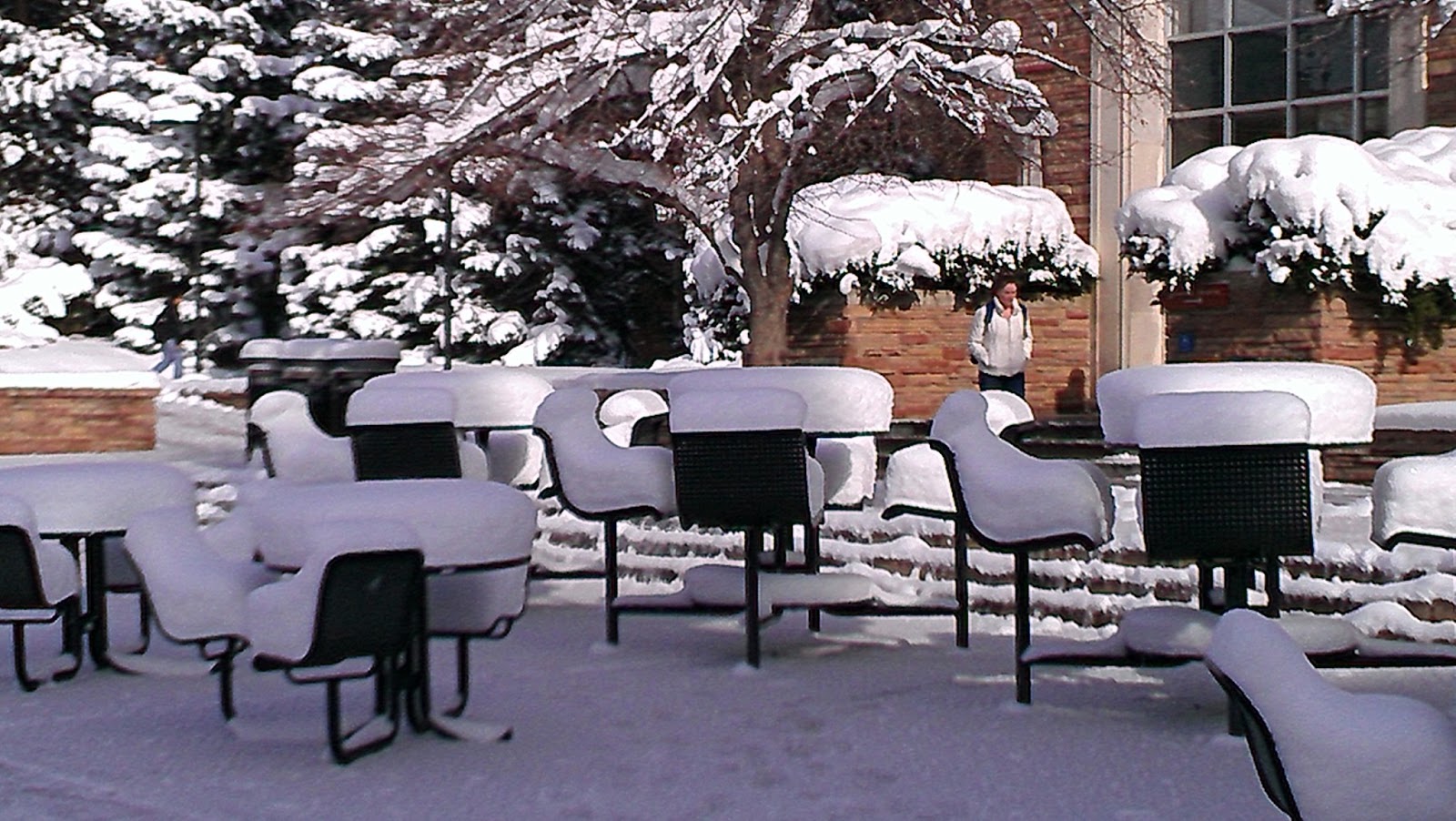
As I write this, I find myself regretting that I don’t have any pictures of these great events to share with you. So to make up for it, let me share some photos of yesterday’s other big event: our May Day snowstorm! 

Here's the view outside my bedroom window this morning


followed by scenes in my yard and bunny prints outside the coffee shop window .


Snow in April—even tons of snow—was a bit unusual, but still tolerable. But May? Boulder got a foot of snow on Wednesday, obliterating the former 6-inch record for the date.

I figure it was Nature’s way of celebrating May Day and all the glorious joy it held.


Tuesday, April 30, 2013

What a difference a mile makes


We just got back from a long weekend in New England. The impetus for the trip was the 30th anniversary of a graduate program where my partner used to teach. The bonus (or, alternatively, the real reason for the trip, with the anniversary simply an excuse) was an opportunity to visit friends from our years in New Hampshire and Massachusetts.

Due to radical changes in the available flights to our old stomping grounds, we ended up driving a lot, which also gave us a chance to remember how lovely spring in New England can be. Like Colorado, New England has four actual, more or less distinct seasons. But given its lower elevation (a mile, give or take a few hundred feet), springtime in New England was in beautiful, glorious bloom.

Here’s a peek at the contrast between late April in New England and late April here. What a difference a mile makes!

April 28 in Western Massachusetts, with bushes and trees decked out in bright spring blossoms:


April 29 in Colorado, with spring just barely beginning to peek out of buds:


It’s always a bit disconcerting to come back from the lush, heavily forested East to the dry, open West. I can see, in these moments, why visitors and newcomers to Colorado—today or back during pioneer days—might see it as barren and harsh. But a glimpse of the white, white 1400’ mountains standing against the blue, blue Colorado sky eases any ambivalence in this old Western heart.

I love spring, wherever it is, blossoming or barely budding.


Tuesday, April 23, 2013

Such a world!

Lately, I’ve noticed a lot of little reminders that time is streaming, rushing past. Things like the announcement I got in the mail recently inviting me to my 50th (!) high school reunion. My first thought was, “OMG, has it really been that long?” My second was, “OMG2, this means I was born in the middle of the last century!” That sounds so like something you’d read about in a history book.

Not long after, we got a message reminding us that the car should be brought in for service. It hadn’t been serviced since August, said the message. “Nonsense!” said I. “I remember sitting in the waiting area, and that sure wasn’t six months ago.” So I looked it up. August. Six months ago. Half a year had passed.

Then a friend was telling me about someone who periodically says to her partner, “We have 20 good years left.” (You can fill in your own numbers.) “We wasted last year, didn’t do the things we wanted to do. Now we have 19 good years left. We’re letting this year slip away. Now we’ll have 18 good years left.”

Thinking of these things calls to mind an icicle we saw last week, hanging from a cornice at the roof's edge, draining the moisture from the snow above. Life is like that. The days just drip, falling away. If you don’t pay attention, they’re gone, and you didn’t get to see them.

All of these moments merge today with my reflections on the Resonance concert I heard last weekend. I've written about Resonance before, and this concert was, as always, wonderful: the rich sound of 130 women’s voices and the singers’ (and the director’s) obvious connection with the music creating the perfect setting for the concert's message. Or messages. I can only speak to the message I took from it, framed by what’s on my mind at the moment. And you know what that is from the paragraphs above.

The concert spoke—whether it was meant to or not—to my current ruminations on the meaning and experience of aging. It pondered with me, it seemed, this realization that time is growing shorter, and that the wealth of it all could slip away while I’m not paying attention. This concert was a celebration of the chorus' tenth anniversary, and former singers were invited to join for a few songs. So I suspect thoughts of aging, change, and the passage of time weren't far from many minds.

The concert was called “Imagine Such a World,” the title taken from one of the pieces. I loved this song. The words are a poem written by a member of the chorus, and the piece was commissioned for Resonance by a member of the chorus in honor of her late partner. The song reminded me, in spirit, of “Praises for the World,” which, as you probably know by now (since I've written about it over and over and over again), may be my favorite piece of music in the world. “Imagine Such a World,” has some of the same feel: This is such an astonishing world. Look! Are we not blessed to have time with it? Listen:

Imagine Such a World (excerpts from the concert program)
by Linda Millemann

Imagine a world where water falls,
just falls,
out of the sky.
A world that offers the soft arm of sleep
to follow every bursting day. . .

A world so longing to be heard
it blooms a meadow full of birds,
so longing for the dance
it sends a pulse of river over rock
of wind  between the  trees
and sways to its own joy
in rippled grassy fields…

Oh, world, almost too much to be imagined
only asking to be met
with our most keenly joyous vow
of yes.
No more.
No less.
Imagine such a world.

This wasn’t the only piece in the concert that evoked this sense of both the depth and the impermanence of life. “Somehow” (from the anti-war piece “Brave Souls and Dreamers”), “Under the Harvest Moon,” “Kinder,” “Love After Love”—all invited reflection on impermanence, joy, nature, sadness, finding yourself, the paradoxical connection between great love (of people, of nature, of life) and great loss. And in the midst of all this, the great grand privilege of being alive, of embracing it all, wrapping our arms around such a world.

I’m framing this all as a reflection on aging—and it is that, for me. But that’s not all it is. This awareness of the simultaneous transience and richness of life may become more poignant, more distilled with age, but the message is no less true in youth. Life is wondrous and short. Don’t wait to notice, because it all passes. Imagine such a world!

Hear for yourself. Resonance will perform this concert again twice next weekend, on Saturday evening and Sunday afternoon. Check out the “Performances” page on their website for more information.

Then get out there and see those icicles before they drip away!


Thursday, April 18, 2013

P.S. to "Aridity and the West"


Speaking of aridity, drought, and over-use of water in the West …

Just after I sent out yesterday’s blog, my partner passed on this article about the Colorado River, which has achieved an ignoble position atop the 2013 endangered waterways list. “Drought and demand are pushing the Colorado River beyond its limits,” the article tells us, “with the needs of more than 40 million people in seven Western states projected to outstrip dwindling supply over the next 50 years. Not to mention the needs of the plants and non-human animals. 

And that reminded me of New York Times article I read earlier in the week about the Colorado. This one speaks especially to the total depletion of the river before it reaches the ocean. The article focuses on projects to restore life in the parched delta—a discussion that’s enlivened by a great embedded video.

The Colorado is just one huge, fragile river, of course. But its fate is absolutely tied up with those of the people, the creatures, and the plants that make their home in the Southwest. Absolutely tied up with the issues I mentioned yesterday—our collective denial that we are living in a semi-arid land, expecting it to provide us with the comforts and amenities of a lush, moist climate. Whimpering at the inconveniences caused by snow, so easily forgetting that it’s all that stands between us and drought.

So that’s why those of us who love the West are actually, deep down, loving this snow. We need the moisture. 


Besides, how can you not feel your breath catch at the sight of this morning, with yesterday's snow brilliant white against the blue, blue Colorado sky


Wednesday, April 17, 2013

"We need the moisture." Snow, aridity, and the West


We’re getting close to the end of the semester, and my American West class, which I mentioned before, is winding down. At some point, I’ll tell you all about it … well, maybe not all, but lots. But for the moment, one particular theme is on my mind: aridity. The defining feature of the West, it seems, is aridity. High desert dryness. A pitiful lack of water. Aridity, it turns out, has shaped the history, the economics, the culture, and the character of the West. 

Now, it may be hard to believe we have a problem with water in Colorado when you look out the window today. Here’s the view I awoke to this morning. 


 My first impulse was to groan; my next was to say, “It’s good. We need the moisture.” 

You might also find it hard to believe that we need moisture if you recall that just a week ago, the CU campus looked like this:


But ironically, these storms are precisely why water is on my mind. 

A little background ...

Early in this class, the professor, Dr. Patty Limerick, challenged us to define what counted as “the American West.” After considerable discussion, Patty suggested that the West can be defined by water—or, more accurately, its scarcity. Geographically, the West begins roughly at the 100th meridian, the “boundary between the moist east and the arid west.” The imaginary line that runs north and south through the country at roughly the Missouri River. Here’s a map so you can see what I mean.


The 100th meridian runs almost exactly along the right-hand edge of that bright yellow section in the map. To the west of that line is the arid West, where the annual precipitation is less than 20” per year; to the East is the moist East, where it’s over 20”. That matters because 20” of annual rainfall is the requirement for things to grow without irrigation.


A bit of history (it’s fun history, so stay with me here). When European invaders of this continent began to move west from their initial settlements along the east coast, they expected that the lush landscape of the east would continue indefinitely. And for a while, that’s just what they found. But when Lewis and Clark’s explorations and then the California gold rush encouraged folks to light out across lands farther north and west, they were startled to find that the land was far from lush. In fact, they found it dry and, from their perspective, barren, foreboding, foreign, frightening.

The problem was that 20” thing. Back east, growing things was never an issue. You could plant crops for food or raise livestock feed without worrying about water. There were also plenty of trees for lumberheck, you had to cut down forests to make room for your cabin. But beyond that mythic 100th meridian, it was a different story. Almost nothing grew without the help of extra water—and water was exceedingly scarce. So they saw the whole center of the nation—from the Missouri across the plains and over the Rockies—as useless and miserable. A place to get through rather than a place to go to.

When folks finally came here to stay, they brought along an ideal for the life that they wanted to create here on the semi-arid high plains: a home just like the one they’d left in the East, where water was abundant. That meant trees, landscaping, and lawns; later, it would also mean water features, swimming pools, and golf courses. All of which require water. Lots of water. And that’s before we even talk about drinking, cooking, and bathing water. Look again at the map. Folks wanted (still want) the water-sucking lifestyle of those lush green areas even though they were (are) now living in the semi-arid to arid yellow and orange parts of the country. Not surprisingly, the 100th meridian also marks a line where population density drops dramatically. Except maybe where water has been somehow corralled (like in large cities), it’s still hard for most people to believe that the West—the plains and desert (too dry) and the mountains (too rugged)—can be a place to live rather than a place to visit on vacation.

Wallace Stegner, a famous historian of the American West, has said that people who choose to live in the West have to deal with its aridity. We have two choices: adapt to it or engineer it out of existence. During carefully circumscribed wilderness adventures, we adapt. The rest of the time, we rely on engineering.

As I've learned about water and its discontents in the West, I’ve become really aware of our disregard for the reality of the aridity of this place. Yesterday, we had a guest speaker, the head of Denver Water, the agency that provides water to about 1.3 million people in the city of Denver. His discussion of this topic was really sobering. Among other things, he talked about the now-two-year-long drought that has left the state parched. You may recall that I whimpered about this in my first-day-of-spring blog and even provided photographic evidence. This picture is also a reminder of what most of our winter has looked likeand a hint at how remarkable the recent storms have seemed in contrast. 


With this drought, the water storage levels are at historic lows, as anyone who has recently driven past Dillon Reservoir (or probably others) can attest. It’s so low, he said, that before the storms of the last two weeks, folks at Denver Water were looking at being down to the “strategic reserve” by this fall—that’s the amount of water you need to meet the city’s minimal needs for a year. The amount you never drop below. The amount you absolutely must keep in case of a catastrophe. Put into perspective, the message is clear: a two-year drought amounts to a catastrophe for our water supply. That’s a pretty thin line.

Our recent snowstorms have made a huge difference. In fact, the storms of the past two weeks have raised the snowpack from 72% of average to 93% of average. (For folks who may not know these things, the snowpack is the depth of the mountain snow that will provide water for the coming year when it melts in the spring.) Not that our average is exactly bountiful, but this is nonetheless very good news. Still, how scary is it that a week of snow storms amounts to about 20% of our total snowpack for the year? Not a lot of moisture, eh? And not a great margin of safety.

Given this dilemma—anyone who’s halfway sane wants to live here, but there is really not enough water—the history of the West has been the history of efforts to, in Stegner’s words, engineer aridity out of existence. Turn the desert into an oasis. We have dams and channels and tunnels and pumps that store water and then send it hundreds of miles away, where it’s used for agriculture, drinking water, and Water World. Some of it gets returned to the system, but lots doesn’t. So much gets used up, in fact, that the Colorado River, the largest river in the West, one that drains seven states and waters countless farms and cities, dries up before it ever reaches the Gulf of California, where its delta has long since turned into a broad, flat, dry desert in its own right.

So now, in addition to thinking snow is beautiful, I’ve gained another level of appreciation for it during these past weeks. The phrase, “We need the moisture” is such a mantra in the West. You hear it every time people start to complain about snow or rain. In fact, I overheard it at my coffee shop earlier today as folks were gazing nostalgically at this scene:


We all say it. I’ve said it all my life. It’s a kind of throw-away comment, a way to bond over shared misery and still make everything be alright. But from now on, I think I’ll be hearing it in a different way. Because I realize that we can’t actually engineer aridity out of existence.

We really do need the moisture.