Monday, March 18, 2013

TRANSformation


When I decided to retire, it was never one of my fantasies that I would hang out on the golf course or sit on the couch eating bonbons and watching soap operas (although the bonbon part has a certain appeal). I know that some folks long for a retirement steeped in leisure, but my own particular penchant is for keeping busy—in fact, not keeping busy is actually dangerous for my mental health. And I guess it’s no surprise that as someone who spent 60 years going back to school every fall, my idea of “busy” includes a whole lot of learning new stuff. Sometimes, this means taking classes—a pastime I have recently raved about here. Other times, though, it just means keeping my eyes and ears open for chances to learn something. Being in a college town helps, of course, as does having partner who is equally eager to keep learning.  

This last weekend, I had just such an opportunity. On Friday and Saturday, CU’s GLBTQ Resource Center hosted the 7th annual “TRANSforming Gender Symposium,” a two-day focus on (perhaps obviously) transgender identity and experience. Notice, that’s 7th annual! Given that trans issues are just now filtering into public (as opposed to activist or academic) consciousness, the fact that this is number 7 is really impressive. Each year, this remarkable event brings in nationally known experts on trans issues, adds a bunch of films and workshops led by local folks, and then invites the whole university and the surrounding community to come learn. The conference is designed to serve both the trans community and folks with other interests in the topic—personal, academic, professional, or simply human interests.

As with other conferences that I’ve written about, I struggle with how to discuss this experience: a “book report,” a story line,  an attempt at synthesis, a “highlights” reel? This time, I think I’ll just tell you about the very best parts of the conference (IMHO), thinking you might add these things to your list and leap at any opportunity to experience them yourself. 
1 
1.    The opening keynote: Eli Clair is a genderqueer writer and activist who has cerebral palsy, which expands his activism in complex and enlightening ways. Eli’s talk was about shame. Specifically, it was about body shame; more specifically, about body shame experienced by trans people and people with disabilities. His presentation was so powerful—lyrical and moving, and at the same time full of information and challenging analyses. I heard one participant refer to it as “academic poetry.”

Eli’s talk wove together personal experiences, links among queerness, disability, class, gender, and race, a poem about eating watermelon, and a recurrent admonition to resist shame. Deep and moving barely describe it. And then came the “Q and A,” which he prefers to call a “community discussion,” insisting he has no answers. But he sure had some thoughtful insights. For example, on the notion of trans identity as biologically based, Eli first acknowledged the importance to some trans folks of a medical diagnosis—it’s the only way to get insurance coverage for transition-related medical procedures and hormones. But on a more fundamental level, he wondered aloud what we tell ourselves when we excuse our identities by an appeal to a lack of choice, a “born that way” argument. Why, he asked, would anyone think that making an ethical choice is less valid than somehow becoming who we already are?

As for marriage and the all-out push for marriage equality, he says, as others have, first, it’s the battle we have. Whether or not it’s the one we might have chosen, it’s the one we have. But as it moves forward, we need to pay attention to who’s left behind. Sure, it will be nice for people to pass their pensions on to their partners. But what about those of us, he asked, who don’t have pensions and never will? 

While it’s true that I agree with the points Eli made—although he made them far more persuasively and poetically than I can—there was so much more to his presentation than his personal positions on thorny issues. His comments about shame, his poetry, his personal recollections were, simply, beautiful. I’m finding it hard to convey the impact of Eli’s presentation, so I’ll just encourage you to watch for a chance to hear him. You’ll be glad you did.

2.    The movie “Intersexion”: This is one of the very best documentary movies I have seen in a very long time. If you click on the link above (“Intersexion”), you can see a trailer that’ll give you a hint. I went to see this film because although I knew some stuff about intersex identity, I really didn’t know much. The “I” is only occasionally included in our alphabet soup (LGBTQI). When it is, the discussion almost always turns immediately awkward because (a) few folks know anything at all about intersex issues—at best, only that it describes folks who don’t fit the “gender binary”; and (b) people are uncomfortable with the  topic—not least because it involves discussions of genitalia and it so totally disrupts what seems like the most obvious of divisions: the biological division of people into female and male.

The movie is based on interviews with a number of intersex folks who have had a range of experiences—from multiple involuntary (and typically futile) surgeries to validating, supportive parents, and everything in between. Some still struggle mightily as adults; some are comfortably at home with their lives. The film also includes some interesting historical, medical, and other assorted factual information—some of which was new to me and some of which I knew about only through psychology’s sort of feeble attempts to address the issue.

Here are some of the things I learned: Intersex is not nearly as rare as we might think. About 1 in every 2000 kids is born with some constellation of characteristics that identify them as intersex. Yet we rarely (if ever) hear about it, so carefully have we hidden it from view, so invisibilized have all these folks been. As one person in the video says, “Intersex isn’t uncommon; it’s just unheard of.” Intersex isn’t just one entity; it includes a wide range of variations on the usual she/he, male/female dichotomy:  variations in genitalia (differences in the presence/absence and/or size of the penis, vagina, labia, testicles); differences in chromosomal make-up (combinations other than XX or XY,  like XXY, X0, XYY, etc.); differences in internal organs and their correspondence to external ones (penis with uterus, vagina with male gonads, all or none of the above, etc.); and lots of others.

The sample of folks interviewed here are likely more at ease with their identity than are many other intersex people—otherwise, they wouldn’t be willing to be on film. They surely represent a tiny slice of the whole population of intersex people. Watching the movie, I wondered to myself which of the many thousands of people I’ve known in my life might identify, if only privately, as intersex. How thoroughly we have stigmatized this human experience—this human variation that challenges our most simple and concrete certainties about the nature of reality—and at the expense of how many people. 


So, those are my personal favorites from a symposium with many other programs to choose from. I’ll be watching for it to come around again next year: the 8th annual TRANSforming Gender Symposium. Maybe you will too. They welcome out-of-state folks.

So much to learn, so little time.


Thursday, March 14, 2013

Civilized!


On Tuesday, the Colorado General Assembly voted to legalize civil unions for same-sex couples in Colorado. To understate the point, this is huge! It’s something activists in the state have worked long and hard to achieve. In this state, it’s made even more marvelous by the fact that just 20 years ago, some folks were calling Colorado the “hate state” for its passage of Amendment 2.

Back then, Colorado was notorious as the (to all media appearances) least LGBTQ-friendly place in the nation. In truth, that judgment was overblown—media frenzies do that. And in truth, Amendment 2 ended up having some very positive long-term consequences—including, arguably, Tuesday’s success. But no one could have predicted that just two decades later, same-sex couples would have that same state’s approval to form legal unions. It’s not yet the whole shebang, and folks were pointing out that it wasn’t marriage before the applause even died down. But it’s a step—a giant step—in this long trek.

Besides, for Coloradans this really is as good as it gets … at least for now. Civil unions are the greatest possible victory in a state that has an explicit constitutional ban on same-sex marriage. We’re not the only state in this particular fix. It’s one of several patterns in the crazy-quilt national patchwork of state-by-state laws that include legal support for, indifference to, and prohibition against same-sex unions of various sorts. The result can be a legal and logistic nightmare for same-sex couples, who may be married in one state, have no legal protection in the next, and see their relationship explicitly negated in a third.

Who can possibly keep up with it all? Well, conveniently, Sean Sullivan, a blogger for the Washington Post, has done us the great favor of summarizing the current status (well, current until Tuesday) of various laws and constitutional amendments related to same-sex marriage (ssm) around the country. To see where your state stacks up (and to be astonished at the piecemeal quality of marriage rights at this juncture), check out his blog here. These maps are really eye opening. Some of them are also clickable, if you want even more detail about your state—or someone else’s, for that matter.

All of this becomes really relevant given the pending Supreme Court consideration of two marriage equality cases, which I wrote about recently. It turns out that the potential impact of these two cases is greatly complicated by this legal hodgepodge. Right now, nine states and DC have marriage equality. The rest have an assortment of conditions ranging from constitutional and legal prohibitions on ssm through various partnership and civil union statutes (and various combinations of the above) to total silence on the issue. The two cases that will soon be considered by the Supreme Court may solve none, some, or all of these discrepancies among states.

One case challenges California’s Proposition 8, which rescinded marriage rights briefly accorded in that state. That ruling could affect only California or, in the broadest case, it could affect all states with legal bans on ssm (like Colorado). The other case challenges the federal Defense of Marriage Act (DOMA; in all federal matters, marriage is between one man and one woman). It argues that it’s unconstitutional for the federal government to refuse federal marriage rights (social security, tax benefits, etc.) to married same-sex partners living in states where marriage is legal. This ruling could have a narrow impact (in just those nine states and DC). Alternatively, a broad ruling could ripple far beyond those jurisdictions, opening the way to broader enactment of marriage equality laws.

To add to the uncertainty, legal technicalities could influence both these rulings and their long-term impact. Basically, the court could decide these cases in a million different ways (approximately). If you’re curious about these things, here’s a pretty comprehensive discussion of the ins and outs of the matter.

Most folks who track these things carefully (which does not include me, except remotely) expect that the court’s rulings will not be so broad as to affect marriage rights in all the individual states. With the current court’s conservative leanings, we might even hope that the rulings will be narrow, since having a negative outcome from the Supremes at this point could stall the movement for a long time. In fact, some people argue that, given the recent rather steady—and occasionally dramatic—progress toward acceptance of marriage equality, we might be better off with the slow, steady slog of legislative and ballot box change. Whatever, hope springs eternal.

Stay tuned. The court will be hearing oral arguments on these cases on March 26 and 27, and they’ll probably issue rulings by June.


Tuesday, March 12, 2013

Foremothers and nowmothers


I’m just back from the annual conference of the Association for Women in Psychology, a perfectly fitting place to have spent International Women’s Day, March 8. The conference was a lesson for me, a lesson in movements and their shifts, a lesson in patience and persistence. A lesson I can always use, since I’m prone to impatience and its attendant crankiness.

AWP conference logo
Reminiscent of Sojourner Truth and Helen Reddy

The Association for Women in Psychology, AWP, was created in the early 1970s as a response to mainstream psychology’s persistent disregard for women—as subjects in their research, as clients in psychotherapy, and as professional members of the discipline. This sort of feminist rebellion was happening all over the place in those days—in medicine and law, history and business, union halls and grass roots organizations, art museums and gyms. Everyplace you looked, women were protesting their exclusion from mainstream society and all its tributaries. AWP was psychology’s most radical version of the rebellion.

Over the years, as psychology has become more responsive to women’s voices and women’s issues—arguably precisely because of AWP—the organization has sometimes languished. In fact, it has sometimes looked like it might die of neglect, as foremothers moved on and younger women went elsewhere. But even in those periods, AWP remained a bulwark, a safe harbor where you could go to present your latest sort of edgy work, hang out with friends and colleagues, and always be safe in the assumption that you were among feminists (including a lot of lesbian feminists). Occasionally that assumption gets tweaked by an odd comment—which can be a bit jolting—but usually, progressive positions (feminist and otherwise) are taken as given. Besides, the atmosphere is wonderfully open and supportive, and the conference is small, which together make it a perfect place for students to enter the professional fray.

These days, AWP seems to be enjoying a resurgence. The offspring of those early foremothers are now themselves mentors, “nowmothers,” of a new generation of feminist psychologists. And recently, those younger folks—graduate students and early career psychologists—have been showing up in droves with exciting new work. So, a weekend at AWP is almost always a treat, and it was this time.

Thinking about AWP’s ups and downs provided the first part of my “lesson” for the weekend. One of the women I virtually always see at this conference is a founding “foremother” who has done consistently amazing work in the field. I’ve never worked directly with her (the closest I’ve come is being on panels with her), but I consider her an intellectual mentor nonetheless. I’ve sometimes wondered why she bothered to stay so involved with AWP during its less stellar years. I have to admit that there were periods when I didn’t go to the conference because the offerings seemed so feeble. Yet, now I'm enjoying this newly enlivened AWP as it thrives on, despite my skepticism. I actually know this about movements—they move in fits and starts, and sustaining them requires not giving into the fits, as impatient folks like me can easily do. Seeing this woman yet again, I realized that I owe the life of this organization to the patient persistence of people like her who didn’t bail, who had faith.

Another version of the same message was delivered by the conference theme and the program supporting it. This organization has tried long and hard to become truly inclusive, and the program this year was a striking example of that effort. The theme was “Voices of Indigenous, Immigrant, and International Women,” and the two keynote speakers were a Thai feminist, Buddhist activist, founder of the International Women’s Partnership for Peace and Justice, and a Navajo historian from the University of New Mexico, whose work is on indigenous feminisms and colonization. The alternative perspectives these women brought—“alternative,” that is, for many of us, but completely central for them—were a reminder of why this sort of inclusiveness is so important. Both of them challenged ideas I usually take for granted—ideas I only realize are culture bound when I hear someone speak from a totally different vantage point. Otherwise, I’m the fish who doesn’t know she’s wet.

Here’s that lesson in persistence again: It has taken years, decades even, for AWP to make this crucial shift. They started from a very privileged position that passively welcomed non-mainstream people and their work to the conference. This despite the fact that the conference was totally shaped by (and for) a white, middle-class, educated, U.S. perspective. Over the years, they have aimed for—and increasingly achieved—a position that actively seeks out different experiences, other perspectives. One that insists on “cleaning house” in all the ways required to make those additional perspectives integral to (instead of attached around the edges of) the conference. The two keynote talks were lessons in this sort of expansiveness. And these women’s presence with us was testimony to the dogged persistence of the organization in trying to walk its talk.

But I don't want my focus on my “lesson” to misrepresent my time at the conference. It was also rich with really interesting small sessions, like a discussion of the evolving meanings of sex, gender, and desirecomplicated notions if ever there were any. (If you’re looking for a hit of confusion, ask me for some readings on this topic.) Then there was a movie about Daisy Bates, the largely unheralded African American woman who was the force behind the “Little Rock 9”—the students who integrated Central High School in Little Rock, Arkansas, during the mid-1950s, the most heated part of the Civil Rights movement. Another session amounted to a guided tour of issues related to race, sexual orientation, and religion. And then there was a video and discussion about micro-aggressions (a concept I mentioned in an earlier post), whose title wins my award for the best concise summary of a topic: “Did you just say what I think you said?”

Besides all that, I got to hang out with some friends whom I don’t often see. One of these women is doing amazing international research, studying LGBTQ activists in other countries. Soon, she’s off to Kyrghyzstan, where she has an ongoing program of work. She speaks Russian, which is helpful to her, humbling to the rest of us. Another was a Salt Lake City social worker whom we got to know during some long-ago research about LGBTQ youth in Salt Lake. Through her, we caught up a bit on the high school “kids” we studied … who are now in their 30s. (How did that happen?).

Finally, to top off the weekend … AWP takes the legacy of its elders/foremothers and its mentor/nowmothers seriously. The annual program always includes a celebration of “crones” (wise old women), and the organization gives an annual award for mentoring. This year, my partner received the mentoring award for her wildly diverse mentoring activities. Over the years, she has served as a mentor (sometimes officially, but more often not) to pre-college students, first-generation (and other) undergraduate students, graduate students, doctoral candidates, post-doctoral students, early-career professionals, and well-established colleagues. She always says she “didn’t do anything,” but plenty of folks thought otherwise and submitted a very impressive group nomination. To celebrate, I bought her a gorgeous purple hoodie with the conference logo. Call me a big spender.

So what, I ask myself, did I bring away from this weekend? (She got a sweatshirt and all I got was a lesson?) I brought these things: A reminder that movements move, but slowly and not always steadily. A reminder that it takes individuals who are willing to stay the course when the going gets tough—or worse, boring. The inspiration of women doing remarkable work around the world, women who share important values with American feminists and who also have a lot to teach us. A mix of regret that my particular life course was ahead of (rather than in the midst of) all the things that are happening these days and satisfaction that those things build on older stuff, some of which I did. Gratitude for the foremothers and nowmothers who created and create the space for all this to happen.

Especially, a deep sense of the continuity of it all. The conveyor belt of people moving the movement.


Sunday, March 3, 2013

Now this is a birthday party!


Stained-glass ceiling, Hotel Boulderado 

I’m getting older this week. Well, OK, I get older every week … every day. But my birthday is this week, which means another year has flown, drifted past while I was barely looking. Time is such an odd thing, how it moves faster the more of it you have experienced. So here I am, about a year older, and my partner and I spent a chunk of the weekend marking the historic event.

The celebration began with a shopping trip, which some folks might think is automatically wonderful. But it’s not usually my favorite sort of outing. In fact, I mostly hate shopping. But this was fun because I actually wanted something particular, and it had nothing to do with styles and fit and trying on. We went to hunt for a new backpack to replace my old one, which is (literally) coming apart at the seams. It’s one of my favorite possessions because it carries my computer (and a lot of other stuff) when I travel—and, increasingly, when I go do my editing at neighborhood coffee shops instead of at home. My cabin fever has been especially serious this winter, and the sunlight and company of coffee shops have proven palliative. So my partner got me this very cool backpack,  which is so special that it even came with a registration policy that promises to find it for me should I ever lose it, and a guarantee against every imaginable danger—even airlines!


Then, backpack in trunk, I was treated to breakfast/lunch at my very favorite restaurant, the original Walnut Café (it was lunchtime, but we both ate breakfast. We usually follow our meals with the ‘Nut’s famous pie, but we passed this time in preparation for what lay ahead). After brunch, we indulged in the ultimate leisure afternoon activity—a couple of hours’ reading at a (you guessed it) coffee shop. My current reading for my American West class is a novel, so I didn’t even have to underline or take notes. Perfectly lovely.


Then, we headed for the Hotel Boulderado. Anyone who lives in or near Boulder likely knows of the Boulderado, the clunkily, perfectly named historic luxury hotel in downtown Boulder. The hotel, which opened in 1909, was built as a showcase of the them-tiny city’s aspirations to greatness. A lot of the original features are still there—including the tiled entryway and the cantilevered cherry staircase, which mercifully includes plenty of landings en route from floor to floor (see “elevator” below). Overhead in the lobby is a beautiful stained glass ceiling—not the original, but that’s a story in itself. However, the (tiny) elevator is the original—complete with a folding gate and requiring a human operator. The last elevator like that I remember was in some department store in downtown Denver during my childhood. (Does that date me?) We’ve never stayed at the Boulderado before and may never again—but it seemed perfect for a b-day adventure!

We took the elevator to our fourth-floor, antique-filled, flatirons-view, corner suite—where I’m certain Joan Baez, Lily Tomlin, Dar Williams, and Helen Keller all slept (I know they stayed there, and what other room would they choose?). Then we strolled down the Pearl Street Mall to dinner at Jax, an up-scale seafood restaurant. Another luxury we’ve never enjoyed before and may never again. After pigging out on seafood and observing the nightlife at Jax, we walked back to the hotel, pausing for an ice cream cone on the mall (thank you, weather goddess!). To finish off the celebration, we had breakfast at Q’s, the hotel restaurant, which we both love, complete with French press coffee. Perfect decadence.

And here’s a really fun part of this story. The stay at the Boulderado and dinner at Jax both happened because we had these great coupons. Now, I’m sure you’re wondering how we got them … so here’s the answer. The coupons were part of a package we bought at the auction at last year’s Open Door Fund dinner (the 2013 version of which is just weeks away). For those of you who don’t know about the Open Door Fund (ODF), it’s a permanent endowment of the Community Foundation that specifically gives small grants to groups and agencies that serve the LGBTQ community. The ODF fund-raising dinner each spring includes a speaker (this year, it’s be Dustin Lance Black, screenwriter for the movie “Milk”), followed by the real entertainment, the live auction. A genuine professional auctioneer, who is a riot to watch, nudges and cajoles and persuades folks to higher bids on both wonderful and improbable items. Last year, folks won trips to glamorous destinations (Italy, Santa Fe), a hiking trip with Aaron Ralston (of “127 Hours” fame), dinner and theater packages, artwork, food baskets, and on and on. We bid on and won a package that included discounts on dinner at a couple of really nice Boulder restaurants (including Jax), an assortment of movie and theater tickets,  and a night at the Boulderado. Hence, our improbably luxurious birthday weekend. I’ve rarely felt so up-town, even though we were wearing the requisite Boulder garb for a night on the town: dress jeans.

We likely would have done some of the things in our ODF package anyway. Some—like the Boulderado and Jax—not so likely. This was hard to beat—an over-the-top birthday party that supported the local queer community to boot.

Plus a swell new backpack. Heck, it was as fun as those cake and ice cream parties of my increasingly distant childhood!   


Thursday, February 28, 2013

For better or for worse


Marriage equality (aka “gay marriage,” “same-sex marriage”—ssm, for short) seems suddenly to be on the fast track toward nationwide acceptance. The speed of the shift seems really breathtaking. But I have to say, I find myself as much troubled as excited by its speed and magnitude. First, more on the trend and then on to the troubles …

This shift toward support for ssm has been in the wind for a while. I’ve mentioned before the growing sophistication of queer organizing around this issue—the smarter messaging, the sharing of resources and ideas across state organizations fighting for ssm (or against laws prohibiting ssm). We’ve also seen hints for a long time in the steady change in the polls. Gradually, over the past few years, public support for ssm has increased; now it’s over 50%.

The gradual trend took a major leap when President Obama “evolved” last year to a position of support for marriage equality. Lo and behold—partly because of his public support, but also because of the two other items I just mentioned—last November saw a sea change. For the very first time, after losing every single electoral battle over the years (more than 30 of them), ssm won in four states: it was approved in three, and a fourth state refused to pass a law banning it. First time ever! Times 4!

Also, the Supreme Court has agreed to hear two ssm cases. Whether that’s a good thing or not remains to be seen. If they rule against it—which could well happen, given the make-up of this court—that will set a precedent that could block serious progress for a long time. But still, the fact that the issue has moved to the fore enough that it’s on the Supremes’ docket is itself amazing.

And then this week, some combination of those events has brought unexpected supporters of same sex marriage out of the woodwork. First, a whole flock (100+ and counting) of noted Republican politicos have signed on to an amicus brief (an argument submitted as a “friend of the court,” or amicus curiae in Latin … who says it’s a dead language?) urging the Supremes to support same-sex marriage. Not to be outdone, today, representatives of a bunch of major corporations—Alcoa, Apple, Citigroup, Facebook, Google, Intel, Nike, REI, Starbuck’s, etc.—submitted their own amicus brief urging the court to grant same-sex couples the right to marry.

It’s astonishing: just one presidential election cycle ago, opposition to ssm was the political default, even for liberal folks like Obama. Now, a short 4 years later, the folks we usually think of as conservative obstructionists when it comes to progressive social issues are stumbling over each other to make the biggest, boldest statement in support of same-sex marriage. And these are important stumblings: some folks argue that these particular amicus briefs, coming from conservative politicians and staunch capitalists, may have real impact in swaying the court toward support for ssm. More impact than briefs submitted by the more natural allies of LGBT equality—human rights and social justice groups, professional fields like psychology and family services, etc.

On one level, this is wonderful, astoundingly good! Equal rights for LGBTQ people are not only being recognized by more and more people; they are being actively promoted by individuals and institutions long considered enemies to that very equality. But let’s not get so carried away by the exhilaration of being seen and supported that we fail to think about the implications of being seen and supported by folks of this particular political stripe. Now, I'm not the first person to have this concern—in fact, I just heard the African-American writer and activist Kenyon Farrow talk about very similar issues in a presentation at CU. But it struck me today in a whole new way as I saw these erstwhile opponents lining up on our side. 

To frame my point, I want to drift back a few decades to the feminist movement in the 1980s. I was teaching a course in the Psychology of Women, and one particular book sprung from nowhere to become the talk of the field. The book was based on what has been called “cultural feminism.” Briefly, this approach says that women and men are inherently different (a position that feminists had been arguing against). But turning the old devaluation of women on its head, cultural feminism argued that these differences are good. Women are actually superior to men, the approach suggests, in many ways that matter—empathy, social connection, a morality of caring, cooperative (vs. competitive) problem solving, etc. Remarkably, even folks who had previously opposed feminist aims loved this book, too. It promised the best of all worlds: you could claim a feminist position without alienating anyone.

Then, some feminists said, basically, “Wait a minute. What’s wrong with this picture? Feminism is a social change movement. If folks who support the status quo love what we’re doing, we must not be challenging much of anything at all.” As people began to analyze this cultural feminist position, the problem became clear. Cultural feminism was popular with supporters of the status quo because it reinforced long-standing stereotypes about women. Sure, it glorified those stereotypes, but as early feminist had argued, a gilded cage is still a cage. Cultural feminism allowed people who represented and wanted to protect the status quo to claim support for feminist aims while actually keeping women in their place.

You see the parallel here. Perhaps it’s time for us to say, basically, “Wait a minute. What’s wrong with this picture? The LGBTQ rights movement is a social change movement. If folks who support the status quo love what we’re doing, we must not be challenging much of anything at all.”

At minimum, we should be asking whether we cease to be a social change movement when our goal is to be assimilated to the status quo. Is same-sex marriage, like that Psych of Women textbook, so well received precisely because it doesn’t challenge the status quo? Because it buys into conservative principles, promising that queers who are brought into the institution of marriage won’t be causing any further trouble, making any more demands? Is “marriage equality” to become our gilded cage?

Now, I get how grand it feels to see Republicans and corporations arguing for our equal rights. That’s a refreshing change! But doesn’t it say something about how progressive the achievement of those rights will really be? Could their support be viewed, instead, as co-optation for now, a debt to be repaid in the future?

“Sure, let them in. That will make them more stable, like us. Make their families look like ours. Make them beholden to the same political and social forces that keep us in line. As long as they don’t do anything different with marriage, let them in. Give them this, and maybe they’ll forget about all those other pesky things they sometimes nag us about. Like immigration reform that honors LGBT families. Support for trans rights. Recognition of a range of diverse sorts of families. Support for homeless queer youth. Separation of medical benefits from marital status. The continuing battle with HIV/AIDS, especially for poor people. The links between LGBTQ people and other oppressed groups. Absorb and divide; divide and conquer!”

And then, once subdued by the gift of belonging, might we find we've indentured the movement for the foreseeable future? As Kenyon Farrow pointed out, might these newbie supporters argue (as they already did in New York, where he lives) that we owe marriage equality to them. “The Democrats could never deliver,” they could say. “It wasn't until we stepped in that the marriage equality movement was finally successful.” Might we be persuaded, and in the process sign on for a whole philosophy that we would otherwise reject? 

I'm not just being a grinch here. I know that being let in, finally belonging feels good. We all want to feel like we’re part of our community. But as a wise teacher/heterosexual ally once said (in a video co-produced by my partner), we all want to be part of the family, but sometimes the family is dysfunctional. I’m not arguing that we should refuse these folks’support, questionable though the motives and outcomes may be. I’m not saying that we should just stand down on the same-sex marriage issue. Plenty of people have much to gain by the success of this part of the LGBT movement. But I am saying that we need to think about this, think about who we’re signing up with, who likes us now. It says something crucial about the movement that these folks are joining in. It says that we are not dangerous, are not threatening to the existing social order, the status quo. And to me, that is a very sad outcome—some would say simply an unfortunate by-product—of a movement whose goal was initially precisely to change the social order.

The LGBTQ equality movement is not about to abandon this particular cause. It may be in for some though times, or we may be witnessing the approach of the end of this particular struggle. In either case, I beg us not to lose sight of our potential for changing the world—as opposed to being absorbed into the world as it is. We have other issues to address, and if we consider our cause won if/when we win this skirmish, we’ll have dropped out of the battle for social change and taken social acceptance as the consolation prize.

And the systems we started out to challenge will love us. How cool is that? (she asked, ironically).


Sunday, February 24, 2013

Einstein's fear


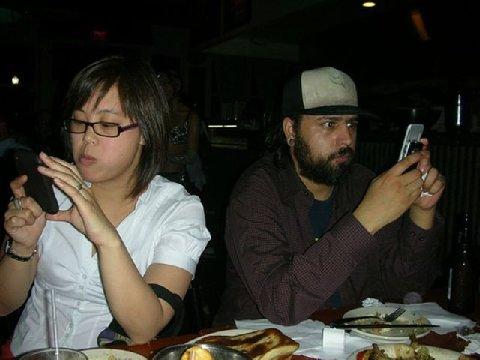
A friend just sent me an email with no message other than pictures:


Lots of folks smarter than me have wondered in print what’s happening to interpersonal—that is, one-on-one, face-to-face—interactions in this age of the smart phone. Smart phones are the new sliced bread, the new better mousetrap, and apparently, the new BFF. Amazing little computers that allow us not only to make calls and share pictures but also to check email, exchange text messages, surf the web, locate ourselves in space, and play games. They also provide a full-service, on-demand time-filler and conversation replacement. One that (seemingly) grants us both means and permission to ignore the people around us. The people with whom we presumably wanted to spend time … but maybe not so much.

Before I launch into this topic, which is bound to stir some resistance among smartphone users (like myself), let me hasten to say I’m not just being a cranky old Luddite, crying “technology is the devil’s playground”! I am happily stunned by the speed of technological innovation, and I honestly don’t belong to the camp that thinks it’s universally (or even largely) a bane, a pox on our social world. On the contrary, I celebrate the access to information and the opportunities for (which is not the same as the inevitability of) enhanced human contact that these new technologies offer.

In fact, I'm an admitted smart-phone carrying believer in the great value of multi-faceted “cyber connectedness.” I love having the Internet at my fingertips. I’ve had many a fun moment with friends looking up some obscure bit of information as we talk over lunch or coffee. I’ve also hunted down restaurants and shops, medical information and book reviews, and all sorts of other valuable kernels on my phone. I’ve used the map function to get myself located when I wandered from my google map directions. I often take advantage of the ability my phone gives me to stay in touch with email—in fact. I rely it to let me know when I have editing work waiting for me. And of course I use my smart phone’s camera a lot, its main purpose being to take pictures for this blog. Going back to its aboriginal use, I sometimes actually receive or make phone calls on it. I know plenty of  folks (myself included) who’ve been in situations where the ability to make a phone call anywhere, anytime has been helpful, important, or even critical. And that’s on top of times when it’s just nice.

So I’m not condemning these gadgets out of hand. I’m not even berating people for using them regularly and frequently. (Although I recently came across an emerging criterion for how many phone-checks per day constitutes “compulsive phone use,” and I may know some folks who come close.) No, my personal discomfort with smartphone use is more specific. It has to do not with the fact or frequency of phone use, but with the context. Basically, my personal concern has two parts, the first pretty concrete, and the second more abstract. They are (1) the preoccupation that morphs into impolite and thence to borderline rude phone use and (2) the curious need to always be somewhere other than where we are.

My first concern about this trend is depicted in the photos above. Here are folks (almost all of them youth, but I know plenty of adults could fill in just as well) who are spending their time “with” friends, but all of them are ignoring those friends in favor of their phones. I’m sure you’ve seen this, too, whole tables of folks having a meal “together” and all of them are on their phones, doing email, texting, surfing, playing games. “Why,” I want to ask them, “why are you ignoring the people you’re with in favor of ‘social’ time with someone else? Can’t it wait?”

Imagining myself in such a group, I would be feeling simultaneously hurt and angry. The hurt part would feel like the other person was being a bit impolite and might want to say, gently, “Could we please spend this time we have together actually being together?” The angry part would see the other person as sort of rude and might say, firmly, “You know, if you really don’t want to spend time here with me, then let’s not pretend we’re spending time together and go on about our lives.” Fortunately, I have been blessed (so far) with friends who don’t have this obsession. I say “fortunately” because I’m not good at such confrontations, and I fear I would just retreat from the friendship in question. After all, why spend time being not with someone you came to spend time with? Still, if this trend continues, I could end up pretty lonely.

But it's not just that being engaged is a kinder way to do relationships. Einstein's comment above points to something important, something we actually know about how people learn and think. It turns out that from infancy right up through old age, our ability to think clearly and in complex ways is fostered by direct social interaction. When Einstein says he fears that technology could bring “a  generation of idiots, he could be citing a large body of research. So this makes me wonder: will smart phones, ironically, make us dumber? Or will they make us, as their name implies, smarter because we have easy access to so much information, so many sorts of interactions?

My second, more abstract concern has to do with our apparent need always to tune out what’s going on in real life by tuning into something, somewhere, someone else. I first thought about this when ear buds started sprouting from peoples’ heads. I'd see someone taking a walk on a lovely day, next to a bubbling stream, the sounds of kids and dogs playing all around—and they're lost in some other auditory domain. Heck, I’ve even seen folks at concerts wearing ear buds. Cellphones with texting capacity gave a boost to this practice of absence, and smart phones have bumped it up another level.

The common thread I’m trying to catch here is our seeming discomfort with just being in the world that we’re inand the concomitant need to find someplace else to be. What’s that about? I don’t want to do a simplistic “be here, now” thing. I just wonder why we are so captured by things that take us to somewhere other than where we are. Is it because we can freely chose those other places, people, activities, whereas the ones in our actual, present environment are forced on us against our will? Is it because that other world is better than this world? Are we so dissatisfied with this place, these people, these sights and sounds? 

Or, to think about it another way, what are we avoiding when we escape into our phones? Are our relationships so empty that they need no tending and invite escape? Are our daily routines so numbing that we look for excitement, novelty, stimulation in a palm-sized screen and tiny buttons? What does this say about how we attend to and nourish our social world? Can't those other worlds wait while we spend some time in this one? Or are our lives so exhausting that we crave escape into some less stressful sort of interactionor into no interaction at all? 

This is a real question: How do we explain to ourselves our absence from our own lives, especially when we disappear in the company of others? 

And, to return to the pictures, what do you suppose Einstein would say about all this? Maybe we have a new slogan, to be embossed as a reminder on smart phone cases: “WWES?


Tuesday, February 19, 2013

Aging: It's all the rage


Lately it's seemed to me that aging has been claiming a growing share of professional and public attention. For example, there’s been a whole spate of interesting new research on aging. Not just biological decline (how to protect yourself against heart attack and falls) and not just fantasyland images (“You, too, can play rugby at 90!”). No, it’s actually about the average aging person, someone rather like, well, my friends and me! And on another plane entirely, a trove of movies have come out that deal with aging in a non-trivial, non-catastrophizing, non-patronizing way. This whole trend is a sign of a phenomenon my partner has long predicted: the baby boomer effect has followed us right into old age.

The baby boomer (hereafter, BB) generation is sort of like the pig moving through the snake—with the snake being a graph of the age distribution in the population—in  2010, the BBs were over 26% of the population. Given this huge demographic, it’s not surprising that whenever the BBs enter a particular life stage, that stage suddenly becomes all the rage in advertising, entertainment, research (especially that for public dissemination), self-help books, and other trend-setting / trend-following circles. Commercials plead to, sales people stalk, service providers cater to, books dissect and cajole, entertainment focuses on, and researchers enroll them.

This phenomenon has had particular salience in my life because I’m right on the front edge of the BB generation. I’m not technically one of “them”—the BB generation officially began with folks born in 1946, so I was a year too early to make the cut. But I grew up with BBs dominating all the social trends, and I benefited mightily from some of them. In truth, I was not usually aware of this. I never particularly noticed that my age group was such a focus—the fish doesn’t know it’s wet. But if I think about it, I can see that for most of my life, whatever we were into shaped what the culture focused on. There were just so many of us!

Still, old people are generally not so interesting in a fundamentally capitalist society—the old are a vanishing market, after all. Fashion designers don’t care much what old people like to wear or what’s comfortable for our downwardly-mobile body shape, and advertisers (except for pharmaceutical companies) seem pretty disinterested in old people, our tastes in, say, recreational activities. But enter the BB effect. For this generation, as perhaps for no previous generation of aging people, lots of concerns, commercial and otherwise, are interested in our interests. Now, it’s not that no one ever cared about old people before, but it’s different now, precisely because there are so flipping many of us.

Consider, for instance, how recently folks were complaining that there were no (zero, zip) decent movie roles for old women. (Old men could still get roles, usually starring opposite much younger female leads.) Yet in the past year or so, there have been a whole flock of movies specifically about people (including women) growing old. These include a very recent splash of stories about people heading off to some idyllic retirement home—a glamorous hotel in India (“The Best Exotic Marigold Hotel”) or a retirement home for former professional musicians (“Quartet”). On the other end of the scale are starkly realistic movies like the Academy Award-nominated French film, “Amour.” Old people (including old women) also show up in meaningful roles in movies that deal only obliquely with age—Judy Dench in “Skyfall” comes to mind. The range of experiences these films depict varies from joyful and enlivening to tender, poignant, and heart breaking—much like the range of experiences that actual old people have. Again, it’s not that movies never before depicted the lives of old people (think “On Golden Pond,” “Harold and Maude,” “Driving Miss Daisy,” “The Trip to Bountiful,” “Away from Her,” “Bucket List”). It’s the density of them now. “Marigold Hotel” had barely faded to BlueRay when its clone, “Quartet,” and its counterpoint, “Amour,” appeared.

Not to be outdone, researchers also have us BBs in their sights. As in art, this work seems no longer to pack us into neat cartons (demented or extraordinary) but to actually comprehend the varieties of experiences that aging people have. A couple of intriguing recent studies:


1.       Cohorts and well-being

Here’s the most interesting study I’ve come across in a while. OK, one of them. It’s about the impact of cohorts on the experience of aging. In this research, “cohort” refers to a group of folks who share important experiences in common. Your age cohort, for instance, is folks born around the same time you were. The baby boomers are a cohort; we share a set of social and historical experiences that have influenced how our lives have progressed. Geographic location, economic status, race/ethnicity, sex/gender, sexual orientation, economic or educational  status … all of these things can influence who constitutes your cohort under particular circumstances.


Not surprisingly, different cohorts have different experiences that might influence how they age. Imagine, for instance, a study of whether older people are more frugal than younger people. You could study groups of, say, people in their 40s, 60s, and 80s and conclude from your results that older (80s) people are more frugal. But that would ignore the fact that people now in their 80s were young children during the Great Depression. They grew up in an era when frugality was a stark necessity. If you concluded that it was age that made them skinflints, you’d be missing the point. Or at least one of the points.


So, the folks who did this study I’m talking about now were curious about widely conflicting findings about age and psychological well-being. Basically, some studies have found that folks’ sense of well-being is fairly stable across age, others have found that it increases, with a slight decline in old age, and still others have reported a U-shaped trend, with relatively high levels of well-being in younger and older ages and a drop in mid-life. The folks who did this study wondered if cohort differences might be muddying the results. So they teased out the cohort effects—i.e., the time and circumstances under which people were born and grew to old age—and the result was fascinating.  


They found that all of the cohorts showed increasing well-being as they aged. But there were notable differences between cohorts: cohorts that are now older started with relatively lower levels of well-being, so their increased happiness still left them short of that experienced by people in younger cohorts. So, although everyone got happier with age, people who were born later started from a level of well-being that was markedly higher than the starting point of earlier cohorts. Their early advantage likely came from many sources: better health care, better educational opportunities, perhaps less economic or social stress early in life, etc. The amazing thing (to me) is that researchers haven’t sorted this out before. But that’s another story, all about funding and “publish or perish” environments, and such. Another time.

2.       Successful aging

This one was another tweak on usual methodologies that led to interesting new findings. Most studies of “successful” aging have used concrete measures that assess things like freedom from chronic disease and physical disability, along with measures of intellectual functioning and social engagement. But one group of researchers wondered about how older people themselves feel about the success of their aging process—noting that they might be in a better position to decide what constitutes success, factoring in their unique personal circumstances and particular goals. (Duh!)

Their results were really interesting. First, they found that older people didn’t think perfect physical health was either necessary or sufficient for successful aging. Far more important in their holistic sense of their own lives were psychological factors like optimism, resilience, well-being, and the absence of depression. In fact, resilience and the absence of depression were as important in their judgments of their own successful aging as was physical health.

Here’s one really intriguing finding: one of the factors most strongly associated with self-rated successful aging was old age. That is to say, older old people rated their aging as more successful than did younger old people. I can think of a few possible interpretations of this: When you get really old, that in itself indicates that your aging was “successful.” Or, alternatively, if you experience your life as personally successful, you tend to yourself better and therefore live longer. Or, resilience, optimism, and an absence of depression provide a buttress against the potential risks of aging. Or, people who live longer also have generally better lives and feel like they are aging successfully. That is, neither one causes the other; instead, both long life and a sense of well-being come from some third factor. Or maybe all of those play a role. Anyway, it's a striking finding, in my book.

Wow, this got longer than I meant it too. Especially considering that my main point was made in the first paragraph: the baby boomers have changed society as they have moved through it. Now that we’re old, society gets to follow us here, too. In the best of worlds, this will turn out to be valuable for the generations that follow us.


Saturday, February 9, 2013

Zombies, Roy Rogers, and the Old West


I’ve been humbled since my last post. Dragged back from my nostalgia and reverie about “the West as I knew it” to the West of today. I was ushered back as Patty Limerick’s class discussed the reading I quoted last time. The one by Dick Lamm about the death of the West. Inviting us to think critically about that sort of nostalgia (“elegy,” she called it), Patty pointed out that the West has not, in fact, died. “Who are we,” she asked, “Zombies?” And as for White settlers being likened to latter-day Indians, she pointed out not only that genocide is not comparable to the loss of farmland (which, thankfully, I had also noted) but also that the Indians are not gone. How dare we, she implied, invisibilize them further by declaring them extinct? Ditto ranchers.

Thus was I reawakened to the world of revisionist history. I had succumbed to the romantic idealization of the “true West,” the “old West,” which is based on what Limerick is fond of calling “the myth of the West”—the great frontier and the grand adventure that ended … when? The story line centering on the “death of the West,” she noted, began back in the 1830s—almost 200 years ago—when the fur trappers declared that the West was lost, dead, because settlers were moving into the frontier. Then, it “died” again when cattle ranchers took over the West from the farmers. And again when industrialization took over the towns and turned them into cities, took over the wagon trails and replaced them with railroads and then highways. Again when the search for energy began to consume the desert canyons and mountaintops.

It’s all part of the so-called settler society. It’s always been layered, one group following upon another, each thinking that their experience was the true West and that it was lost to invasion by the next. My personal experience with this progression centers around Moab, Utah, in the 1970s and 80s, when you could hear the resentment of local “natives”—descendants of farmers and miners—as they railed against the hikers and environmentalists … and then more recently as those very hikers and environmentalists rail against the mountain bikers and t-shirt shops.

Well, unless we’re Zombies, this is the West. For now. Enter Patty Limerick’s Roy Rogers Hypothesis: “Western reality and the myth of the West are entirely intertwined. You cannot understand one without the other.”

Back to my comeuppance. The irony of my (uncritical) embrace of Lamm’s nostalgic, romantic, elegiac view of the West is not that it was “wrong.” It’s that I know better than to think that it’s right. The sort of “deconstruction” that this class encourages—the practice of looking for what’s missing, who’s telling the story, who benefits from this view over other views, what’s hidden behind the obvious story line—is exactly what I did in my own field before I retired. But lo and behold, when it came to a topic this close to my heart (and so distant, apparently, from my scholarly instincts), I forgot to do it.

The requirement that I find enough psychological distance from this topic to consider it more critically changed my whole relationship to this class. Now I’m really a student again.


Tuesday, February 5, 2013

Cows?


You may wonder why I’m starting a blog with a (small, dark, somewhat blurry) picture of cows at sunset. Sure, the sunset is beautiful, but couldn’t I have picked a better foreground scene? Or a better picture? Well, as it turns out, I was actually thinking about cows as I drove past this little herd this evening, so it seemed a perfect opening shot. Here’s why:

I’m taking an amazing class from an amazing woman at CU. The class is “The American West,” and it’s being taught by Patty Limerick, arguably the smartest and funniest cultural historian of the American West on the planet. CU has this great “Senior Auditors” program that lets any old person sit in on virtually any class, as long as it’s not full of tuition-paying students. I got lucky and squeezed into this one.

The topic called to me because the West is my home. I’ve lived here all my life, with the exception of graduate school and one other sojourn around the country. I feel like I have a soul-deep relationship with the West. I’ve explored huge swaths of it by car, on foot, on skis, on snowshoes, by bike, by camper, and by canoe. Still, in the first few weeks of this class, I’ve learned more about the West than I even knew. By far. Besides, Patty’s humor and broad knowledge make every class (and even the handouts) a total kick. Recently, she challenged the students to support the argument that CU should have the cow instead of the bison as its mascot … which is why I was thinking about cows driving home.

Lots of what I’m learning goes beyond sheer content, slipping into what some folks have called “revisionist history” or “critical history.” Instead of just a review of people and events, this approach really examines the deeper meanings of what was going on and listens to the voices of people who usually aren’t heard (i.e., voices other than White men being politicians and soldiers). It also challenges long-held assumptions about the nature of the West and its popular portrayals.

Even though only three weeks have passed, I couldn’t begin to list all the mind-bending things I’ve encountered. Let me just highlight a few themes. 
  • Question on day 1: What counts as “the West” anyhow? Is it defined by geography? Is Los Angeles part of the West? Is Hawaii? Is it defined by culture? Is Texas more West than, say, Oregon? What makes the West different from other sections of the country? Wilderness? Water (or lack thereof)? Open spaces? Cowboys? Buffalo? Sparse population? If it’s any of those, is it still the West if water is piped in, the Buffalo disappear (or exist only in captivity), open spaces are filled with developments and traversed by highways, and the only “cowboys” are country western singers? Or is it simply the nation’s dumping ground—for people (Indian reservations) and nuclear wastes (Yucca Mountain). And whatever your response to these questions, why? 
  • The West has always represented two very different visions, two urges: the longing for wilderness, adventure, unbounded freedom … and the striving to conquer that wilderness. That was true during the westward movement. The “frontier” was wild and dangerous, until it became valuable, and then the cowboys and gunslingers, gold miners and settlers, ranchers, cattle barons, and farmers moved in. The standard story line of Westerns—peaceful little town saved from villainous thugs by the noble lawman—reflects the real-life battle between those who wanted freedom and adventure (gunslingers, cowboys) and those who wanted law and order (towns folks). Some people wanted open range (freedom) others wanted fences, farming, and towns (wilderness conquered). And the conflict persists today. We crave open space, remote wilderness where we can “escape from it all.” But recently, even that remaining remote wilderness has been increasingly paved and developed and populated. Partly by people (still) wanting to “get away from it all”—to find “wilderness” among the manicured lawns and paved walking paths. But mostly by economic interests who found something valuable in the land to conquer. 
  • A very huge portion of land in the West (but not in the East) is federally owned. Much of the land that’s farmed, much of the land where cattle are raised, much of the land where minerals are extracted is federal land. Those economic activities take precedence over recreation, over environmental concerns, even over social and cultural values. The ones that make the biggest bucks (mining) take precedence over the less profitable ones (farming, ranching). Put those together, and you have a West that is rapidly being eaten up by energy interests and the cities that support those interests. And the highways and railroads that connect those cities. So now what counts as “the West”? 
  • Familiar portrayals in “Western” movies and books notwithstanding, the West was (and still is) an extremely politicized place. Lots of what we “learned” about the West happened right around the Civil War, though you’d never know it, and the history of the West was deeply shaped by that war. Jesse James and his gang, for instance, were outlaws regarded as heroes because they were seen as standing up for the dying South and against the corporate, industrializing North. The other major conflict was between the West, with its frontier mentality, and the Northeast, with its industrializing, corporate frame of mind. Train/bank robbers were seen by some as heroes because they challenged the “incorporation” of the West and by others as villains because they interfered with the imposition of the new industrialized social order. 
  • The (mis)treatment of the West and Westerners—especially ranchers and farmers—at the hands of the East and Easterners, both in the “old West” and more recently, has been equated by some to the treatment of the Indians by White settlers moving west. In each case, the people who were on the land were summarily moved off, their lands confiscated, and their lives discounted in the name of “progress.” In the case of White Westerners in the recent past, it has been in the name of energy development. Some Westerners who have been treated this way comment that now they know what the Indians felt like. (Not entirely, I’d say—genocide is hardly the same as losing the farm—but it's an interesting parallel.) The players are different, but the dynamic is the same—as is the direction from which the oppression has come. You begin to get an idea of why Westerners often feel like Easterners don’t understand the West—not the land and not the people.

 All of this has been thought provoking and even moving. But I think the most poignant piece I’ve read so far was the prologue of a book co-written by Colorado’s former Governor Richard Lamm. A few lines from that piece:

There was something special about the West in the 1950s and 1960s.
It was a unique and wondrous place for those who loved the outdoors, who cared about the land. Its air had an unbelievable quality. It literally sparkled. In the mornings, the mountains and desert and farmland stood out in crystal clarity. And the sun shone with a special brilliance, a counterpoint to the coolness of the mountain air.

Not many years ago, you could still catch a native trout. Float a lonesome river. You could escape the regimentation and restrictions of the civilized world.
We took it for granted drinking from a running brook … being able to camp at random, safely and in privacy … the chill feeling of space, infinity, at a mountain dawn.

We saw the West change before our eyes, but the images, the memories still linger.
This was our West.
And it is dying.

A new Manifest Destiny has overtaken America. The economic imperative has forever changed the spiritual refuge that was the West.
We know the West will never be the same again.

We understand.
But still we anguish. For the West we loved and lost.
                       
                        The Angry West: A Vulnerable Land and its Future. (1982)
by Richard D. Lamm & Michael McCarthy. Houghton Mifflin


Now, I can be about as nostalgic and anyone I know. And the West that Lamm and McCarthy write about is a version of the West I know, well. And miss. A lot.

Still, I realize, now, that there is so much more to the West, so much more to understand. And I realize how lucky I am to be taking this class.


BTW: I’m also taking part II of my Spanish class. Estoy mucho aprendiendo, pero aún no hablo español. Stay tuned ...


Saturday, February 2, 2013

Ageism Take 2


Last week (was it really that long ago?), I talked about an encounter with ageism at a conference on multiculturalism. That particular experience felt especially awful coming as it did in a setting where the appreciation of difference was explicitly the topic of the conference. Granted, the presentation that troubled me was conducted by white, mid-life academics. But they might have called on their experience as women to notice that talking about people without including those people in the conversation might feel yucky. Heaven knows women have had plenty of those experiences (recall “Women’s bodies have a way of shutting down during legitimate rape,” spoken by a man who presumed to know).

Anyhow, this past weekend, I had another such experience. Again, it was in a context where I would hope it wouldn’t happen: the annual “Creating Change” conference sponsored by the (to my mind) premier LGBT rights organization, the National Gay and Lesbian Task Force (NGLTF, a.k.a. The Task Force). In my happiest fantasies, LGBTQ people would be so sensitized to oppression that they would never participate in it themselves. Especially folks attending this conference, the most politically active, politically sensitized, broadly progressive conference I know. But there it was. Subtle, mostly, but recognizable—at least from my hypervigilant perspective. The sort of ageism that made me ask myself, “Wait, was that ageist or not? Am I being too sensitive? Where’s my sense of humor?” All of which must sound familiar to feminists, queer folks, people of color, working class people, people with disabilities … all of us who find ourselves questioning whether mistreatment is “real” or “imagined.”

It’s not the first time in my life I’ve had these experiences, the daily barrage of what psychologists call “micro-aggressions.” I first became aware of them during my feminist awakening, then got re-acquainted as I sorted through my sexual orientation and then engaged the world as an out lesbian. I’ve also learned about them through the stories of people in other oppressed groups. But I still expect (or maybe I simply hope) that these micro-aggressions won’t happen when I hang out with the very folks who have been the targets of so many of them. Somehow, I expect them to recognize bias when it happens, to challenge it in others and refuse to engage in it themselves. And that was my expectation of folks at Creating Change.

Unfortunately, few of us are as skilled in this sensitivity toward others as we wish others were toward us—I’m certainly not. For instance, although I try not to say or do things that are racist, classist, adultist, etc., I sometimes find myself saying or doing those things anyway. Heck, I even say or do sexist and homophobic things sometimes. I’m actually happy when I catch myself doing this—enjoying what a friend calls “another god damn learning experience.” For one thing, I’m happy to realize that I was at least conscious enough to catch it (or to “get it” if it’s pointed out to me). Besides, it’s a reminder of how deep this stuff goes and how hard it is to root it all out. When I remember that, I can be more understanding of other folks’ “slips.”

So, bummed as I was about encountering ageism at Change, as we call it, upon reflection, here’s what I realized. One of the great joys of Change is that it is full of youth and their exhausting, limitless energy. That makes for noisy nights in the hotel, but it also infuses the conference with this buzz of possibility and a sense of wonderful forward momentum. When I’m at Change, I don’t worry at all about the future of this movement.

At the same time that I love this youth-drenched energy, I realize that the movement and Change itself increasingly belong to generations that have had little contact with old people and little opportunity (much less encouragement or requirement) to think about ageism. So, the perspective that they bring to this conference is shaped almost entirely by this culture’s pervasive ageism. By the stereotypes and biases that float around in the air, the images we've all  taken in during our lives—and that most of us only begin to really, deeply challenge when they apply to us. These gut-level, ingrained beliefs and attitudes are usually not spoken out loud. Often, they’re so widely accepted and unquestioned that we don’t even know we have them. Psychologists call them “implicit attitudes” exactly because they’re not explicit. We could even call them unconscious.

So, folks working in this area (like, as a random example, my partner) point out that people can’t change these attitudes until they become aware of them and actively work on changing them. Despite our best intentions, these things are so well learned, so … implicit … that unless we take active steps to recognize and change them, we’re basically stuck repeating them. For me, this means that if I really want ageism at Change to change (what a convenient double meaning!), I have to do something about it. These young folks who are flooding into the movement haven’t had any means of learning about this issue. They likely have no idea what ageism is, much less what it looks like in everyday practice—and even less awareness that they are practicing it, big time. It’s not only youth, of course. I heard plenty of ageism from grown-ups (even old ones), too. So, if I want these well-intentioned, generally progressive folks to look at their ageism, I need to try to give them some information that will help them do that.

You can see where  this is going. I guess my task is to develop some sort of program for Change next year that will address ageism. Not that I can single-handedly rescue the movement—or even Change—from ageism. But doing something on this order will serve at last two purposes. First, it may begin a conversation that will help some segment of my fellow Change-rs to notice, think about, and work to change their ageism. That would be way cool. Second, it will help me take some control over my own response to this issue. After a couple of these encounters, I was on the verge of deciding not to go back to Change. That would be a huge loss for me. Doing something positive about my discomfort would be so much better.

I told my partner earlier today that sometimes blogging gets me in trouble (which she reframed  as holds me accountable”). Last week, it made me commit to writing to the lead panelist from the earlier conference (which I have now done). This week, it leads me to commit to developing a program for next year’s Change conference. 

My response this week is the same as last: thanks for the nudge. Stay tuned ...