Showing posts with label abelism. Show all posts

Monday, May 11, 2015

Hijacking the self-driving auto: A short story


Foreword

You’ve probably heard about Google’s driverless car, currently being tested on roadways around the land, and now we’re hearing about Chrysler’s roll-out of a self-driving semi—imagine seeing that in your rear-view mirror. To be totally accurate, I guess these are not driverless vehicles. It’s just that the actual “driver” is a robot of some sort, a computerized master executive that gathers relevant data and directs the vehicle appropriately. Besides, at this point, at least, there still needs to be a human “back-up” driver to take over if things don’t go as planned. This new, no-longer-futuristic technology crossed my mind as maybe a perfect analogy for my current quandary. Here's the story.

Chapter 1 

The other day, I was having lunch with a friend, and we were talking about life and aging and adventures and such—common topics for lunch with this long-time friend. As she talked about her travels in recent months and her plans for a very active summer, I had this “ah ha!” moment. I hadn’t thought about it in advance and didn’t quite understand what it meant, but I explained it to her like this: I feel like my life is in a bit of a rut. Too much sameness. Every day is just every day. Even “events” fall into predictable categories and sort of run together. I hadn’t especially noticed this, although I had felt a bit cabin feverish over the winter. But now I had a hint of what was behind this small sense of ill ease that had been floating around my mind of late—not acutely troubling, just vaguely nagging. I said to her, “I need something extraordinary in my life.” Not something monumental or extreme. Just something extra-ordinary. Something that marks a moment, a day, even a year as special, different.

So, I’ve been reflecting on that comment for several days, trying to understand what I meant and what I need to do. Slowly, but purposefully, I’m beginning to craft some ideas about what I’d like my life to hold that would feel extraordinary. Temporary adjustments, to be sure, but perhaps that’s the point—keeping my life populated with temporary extraordinary moments. Some ideas have come to mind and are slowly shaping themselves into plans. Among them, I’m eager to write more—which means doing things other than gazing at the sides of a rut, as ruts have little to offer as literary devices.

Chapter 2

Driving to the gym, I heard a short segment of a TED talk, part of a series on the theme of “identities.” The speaker said something about how important it is to be clear about your identity. That isn’t necessarily, she said, where you live or what you do for your work. It’s more about what matters to you, what you value and what principles you represent in your life. This is not a startlingly novel proposal, but given my frame of mind, her words hit home. I realized that I didn’t have a clear answer (even for myself) to her question as I heard it: Who am I in the world? If I looked at myself from the outside, what values would I see? What do I stand for? What message does my life convey to those around me? How would I describe my place, my meaning in the world?

Of course retirement plays a role in this. I’d venture to guess that this question is familiar to many retired folks, since we often can’t call on the things that used to define us—occupation, family role, position in an organization, etc. Still, there have been times in my life, before and since retirement, when an answer to that question was much clearer. But right now, it’s not. In that moment’s thought, I realized that my life has become pretty self-absorbed. It strikes me that events of the past several months may have nurtured this frame of mind—some deaths in the family that have made my mortality all too evident, my own struggles with health issues, changes in my habits (induced by routine, laziness, boredom) that have kept me inside, at home—all may have contributed to my sense of disconnection from the larger world.

So now, it seemed, my “extraordinary” task looked three-fold—and, paradoxically, more ordinary: to create extraordinary moments in the everyday, to be sure that some of those are about something bigger than myself, and to write more about it all.

Chapter 3

As it happens, just before my trip to the gym, my partner had mentioned an article she just read about changing norms regarding disability language—i.e., how people with disabilities prefer to be named. It sounds fascinating and important, a window on dramatic shifts in the world of disability and disability rights. I expressed interest, which was totally genuine, but I didn’t think much about doing anything more with it than reading it and discussing it with her. She even suggested it as a blog topic, a proposal I set aside. But after the “identity” comment, I thought about it again. The article and what I might do with it now embodied just the sort of thing I’m looking for—something out of the ordinary, something that meshes with the values I want to represent, and something to trigger write-able thoughts.

Chapter 4

I came home from the gym to find a Smithsonian article about this self-driving semi. Nice analogy, I thought: I’ve been taking a ride in a self-driven vehicle that’s nicely programmed to follow the same routes, safely traversing the streets of my life without much thought from me. Safe, maybe, but being safe is not the same as being alive.

So then I wondered: It this just another version of a recurrent theme in our lives? Does everyone have these periods—you realize that you’ve gone on auto-pilot and that it’s time to grab the wheel? I bet so … or at least lots of us. I know I’ve been here before. On one occasion, I remember writing here about computer ruts, and on another, talking about making summers noteworthy—a different focus each time, but a similar point. And I expect I’ll be here again. This time around, it just took a spontaneous comment to call my attention to my own ruttedness, jerk my attention back to the road and, to stretch an analogy, the many other roads I could be traveling. Once that happened, things started to move, to shift. Now my job is to turn off the auto-pilot, stay alert, get busy driving my life, and open my eyes to the possibilities for extraordinary moments. Summer seems a perfect time to do that.

Afterword 

Stay tuned: there may be a self-driving vehicle commandeered by a genuine human traveling the streets near you, headed for something extraordinary. We could make it a caravan, if you’re so inclined.


© Janis Bohan, 2010-2015. Use of this content is welcome with attribution and a link to the post. 

-----------------------------------------------------------------

To comment on this post: 

If you got this blog via email, go to the blog website by clicking on the title at the top of this particular post.

To comment on this post from the blog website, click on "No comments" (or "2 comments" etc.) right below the blog entry. Comments from "anonymous" welcome.


Friday, March 21, 2014

‘The Lived Experience of Disability’

Last time, I wrote about my gradual evolution toward a clearer understanding of disability issues. That blog focused on abelist language, just scratching the surface of what I’ve been thinking about lately in this general domain. It also mentioned a conference that offered me an opportunity to learn—and to reflect—more about this topic. The organization that sponsored this conference, the Association for Women in Psychology, has worked hard over many years to address issues of diversity. But this was the first time the conference has focused on a particular dimension of diversity, in this case, ‘The Lived Experience of Disability.’

This conference was in Columbus, Ohio. Not an ideal setting for a mid-winter conference, it seemed to me. I'd never thought much about Columbus, Ohio (except gathering from the song, "Hello Life, Goodbye Columbus" that it might be a place better left behind), and I didn't expect an exciting locale. But I did manage to learn some interesting facts about the area. For instance, Ohio played a very large role in the Civil War (Gens. Grant and Sherman were both Ohioans, as were other major generals and several members of Lincoln's cabinet), and as early as 1828, Columbus was a very early stop in the Underground Railroad. I also spotted some interesting architectural contrasts, public art, and community culture. I'll share a few photos from my pedestrian journeys while I tell you about my attitudinal journey. 


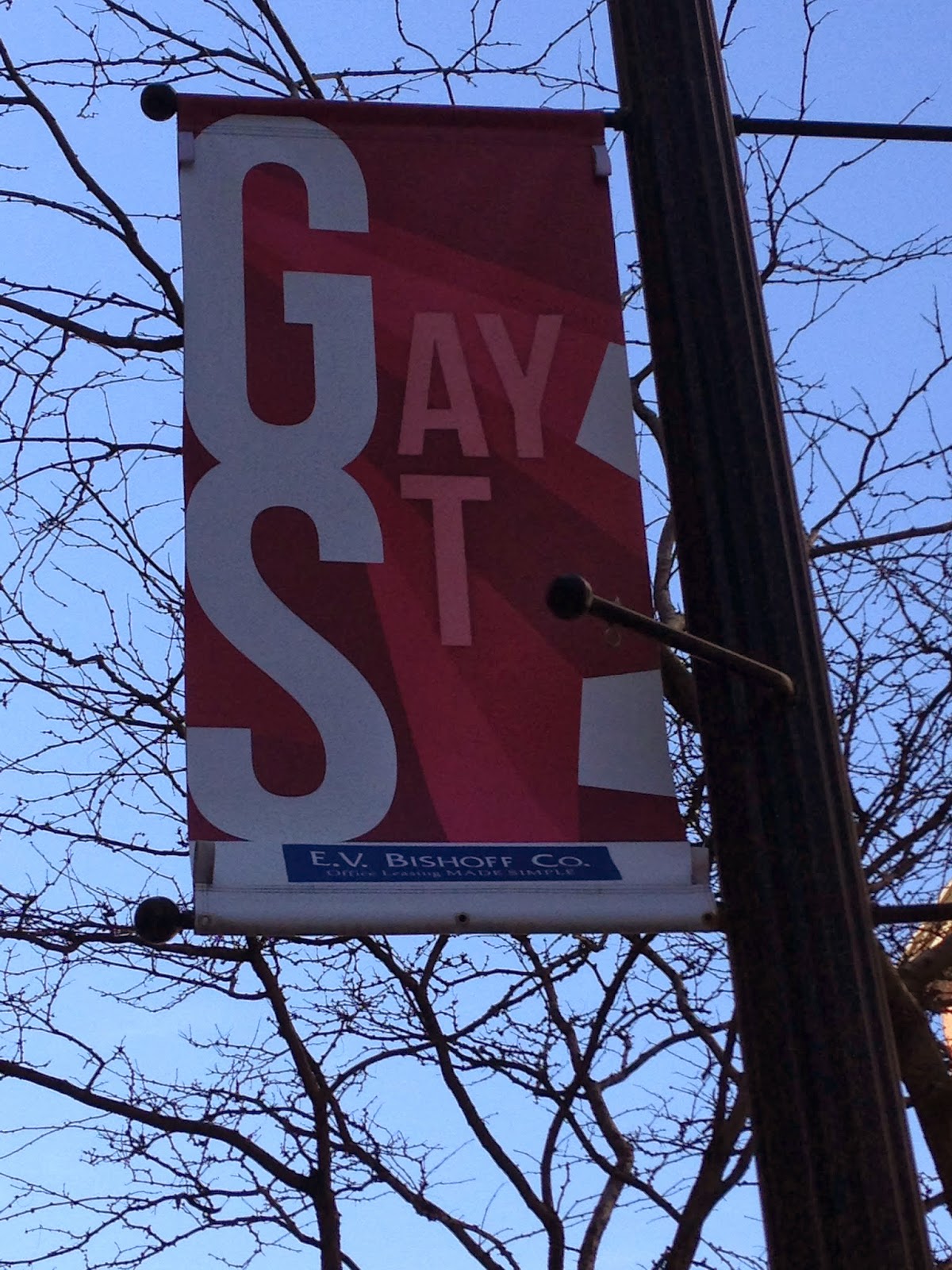
For starters, here's the street sign outside our hotel. Not a bad beginning ...


I knew almost immediately that this would be a good experience for me when I looked around the conference hotel and saw that I would be spending a few days in the company of many people who did not share my ability status. I wondered how this felt to them—to be in this company, perhaps for a change, not alone. I was also immediately aware of my own lack of facility in this situation. I wasn’t sure how to be, how to act, how to interact with these women. Some of my awkwardness stemmed from my sheer lack of experience. Some came from wanting so badly to do it ‘right’ and realizing how little I knew about what that would mean. And some was the awkwardness that comes from being confronted so directly with my privilege—with a piece of my privilege that I rarely have to look at.

This was a multi-day conference, and I went to a lot of sessions, most of them about disabilities. I won’t even try to summarize them all (You’re welcome). Instead, let me share just a few things that had particularly strong impact for me.


First, I was struck by the many parallels between ableism and ageism. In each case, the member of the ‘target’ group—people with disabilities and old people—are infantilized by those who don’t belong to the group. They’re treated as incapable of managing their lives, as constantly in need of care, as dependent on others. I so empathized with the speakers who said, basically, ‘Don’t always assume I need help. I’ll ask if I need you to do something for me.’ How many times have I had people offer, insistently, to carry my stuff for me, to open a jar, to help me with a computer, to do a million things I’m perfectly capable of doing.

Still, on reflection, I realize there are also huge differences: we are old only during one, relatively short part of our lives, whereas many people live with disabilities for much or all of their lives. People with lifelong or long-standing disabilities live with the associated stigma and with the demands of an abelist world for many years—even a lifetime. That means more years of discrimination and dismissal by that world—and it also means more years of resilience and competence despite that world. How does all that translate into the lived experience of aging as a person with a disability? I don’t know, but I’m sure it adds complicated layers that my aging doesn’t include. Also, there’s the reality that my aging entails a huge loss of privilege. I’m used to a world that worked pretty well for me—sexism and homophobia aside—and now it doesn’t. My outrage at this shift tells me something about the level of my privilege before it. And I can only wonder how this same shift is experienced by people with disabilities, for whom the world never worked so well.


A second thing I learned at this conference—also about my own privilege—is how rarely I have encountered to any great extent the ‘lived experience of disability.’ How few people with disabilities I have known, especially well. How few workshops or even single presentations about disabilities I’ve attended. How few people with disabilities enter my life in any venue—social, political, educational, cultural. Thinking about this made me realize how easy it is for us to miss these experiences—either through active avoidance or simply because our world is arranged in such a way that we don’t invite or create these interactions. This, in turn, makes me aware of my own privilege … again. Privilege has been defined as the absence of a need to think about your identity because the world is set up to work for you. White people don’t have to think about race, men don’t worry about gender, and the able-bodied world doesn’t have to think about disabilities. To do it, we have to want to, we have to think it matters. Otherwise, life colludes to protect us from dealing with it.


My third ah ha moment came in a discussion of deafness following a panel on the topic. An audience member posed a question about a hypothetical woman, an ally to the deaf community, who knew American Sign Language. What should this woman do, the questioner asked, if her partner refused to socialize with this woman's deaf friends because the partner couldn’t join in their conversations. The panelist replied that the partner might consider that s/he doesn’t have to understand everything that happens in order to be present and social. The partner might consider that this is the experience of deaf people all the time—they may pick up snippets of conversations, missing most, often without others recognizing that fact at all. And then, my favorite part, the truly eye-opening, consciousness-raising part, was when the panelist suggested that if the partner really wants or needs to understand the conversation, then the partner might hire an interpreter for her/himself.

I loved this answer—it made my privilege (and my previous lack of awareness of it) so crystal clear. Why, I asked myself, should ‘they’ always make adjustments to make me comfortable?! Why aren’t I obligated, especially if I’m entering their social circle, to make accommodations instead of expecting them to? Without her answer, I would have been left thinking that some arrangement should be made for the partner—either the partner doesn’t come or the deaf people translate for him/her. A definite ah ha moment.

I also realized, by the way, that I have done a very similar thing with a bilingual friend and her family. I avoided spending social time with them because they spoke Spanish together. They would speak English on my behalf, but that didn’t feel fair. At least I knew enough to recognize that. But why, I now ask myself, didn’t I find some other way, uncomfortable for me or not? What sort of rich experience might I have missed?


And the final story: I saw a movie that featured people with a variety of different disabilities talking about their lives and their encounters with ableism. One woman, talking about how she would like able-bodied people to relate with her, said, ‘Don’t pity me. Don’t think of me as different.’ There was something in that moment that shifted my understanding. Of course, my first response to people with disabilities is likely to be exactly an awareness of their difference—that’s how we code people, by differences. The problem arises when that differences is seen as all-encompassing, and especially when ‘different’ equals ‘wrong.’ A lot shifts for me when I consider this proposal: Disabilities are no more salient than any other difference except when they are. Using a chair is no different from any other form of difference, say, being being tall or short, except when it is. It’s about context. Sometimes, using a chair matters, and an awareness of how it matters and what that asks of me is good. But when it doesn’t matter, that particular difference recedes, is not a difference that makes a difference.

I’m reminded of a famous poem that my partner often invokes. It’s by Pat Parker, a Black, lesbian, feminist poet. The poem, called For the white person who wants to know how to be my friend, starts like this:

the first thing you do is to forget that i'm Black.
Second, you must never forget that i'm Black.

In the same spirit, the point is not that disability doesn’t matter or that we mustn't recognize its impact. It's that it doesn’t matter except when it does. That distinction may not always be easy to discern. But it opens the way for those of us who are (at least temporarily) able-bodied to get past the privilege that lets us either avoid considering disabilities or insist on seeing them as all-encompassing. And that, in turn, lets us get busy with the work we need to do.

And that’s where I am today.


Monday, March 17, 2014

The language of abelism

I’ve thought a lot about language over the years. I’m especially interested in how language shapes the way we think, how we see reality. For instance, if a place is called a ‘city,’ we expect it to be a certain size and have certain amenities that we don’t expect if it's called a ‘town.’ When we call a task ‘challenging,’ we approach it differently from when we call it ‘impossible.’ This applies to how we see people, too. Like, when we call grown males ‘men’ and grown females ‘girls,’ we’re implying that males become adults, while females remain children. How could we not think of women as weak, dependent, emotional, and incapable if we think of them as children?

Language also shapes how we see ourselves. If you hear a hostile label often enough, you can’t help but absorb the negativity of it. Get called ‘ugly’ often enough, and you’re likely to believe you’re ugly. Get called ‘clumsy’ often enough and you’re likely to avoid all the activities that might embarrass you. Some of this is simple self-fulfilling prophecy. But there’s more. The subtle, non-obvious internalization of this sort of label can eat away at your soul.

Not surprisingly, I’ve thought about this especially in terms of how language has been used to demean and dismiss me—as a woman, as a lesbian, as old. But I’ve also learned enough about it over the years to be sensitive to the impact of other forms of debasing language—the language used toward racial and ethnic groups, for instance, or toward poor people, religious minorities, people with disabilities. Most of us are learning these things on the fly, trying to keep up with changing norms for what’s viewed as respectful language. But it seems like we all have areas where our vision is fuzzy, our ear is ill tuned, where we miss the hurtful messages that our language conveys. When I do that, I’m always happy if someone helps me realize it and correct it. (OK, I’m not initially happy. I’m embarrassed, even ashamed. But on reflection, I’m happy and appreciative.)

I mention this for two reasons. First, I had one of those moments just the other day. I said something to my partner about ‘foreign students.’ As soon as the word came out of my mouth, I regretted it. I know better. The word ‘foreign,’ while totally correct as a vocabulary term, carries a boatload of extraneous meaning. We use it to mean odd, frightening, out of place, something (or someone) that makes us uncomfortable. So using it to describe international students effectively describes them as ‘other,’ like they don’t belong. That’s not at all the message I want to convey, and it really isn’t what I meant. But it is what I said. My partner often talks about the difference between intent and impact. When we’re trying to be kind and respectful, it’s important to think of impact and not just intent.

And the second, related reason I mention this issue is that I just attended a conference that gave me an opportunity to focus some thought on an area of diversity where I’ve not done much work—namely disabilities. I’ve known that our culture has a lot of work to do around disabilities, and I’ve made an effort to include this issue when I enumerate the many groups whose rights and contributions need to be honored. I’m aware of some nuances of disability-related language that matter (e.g., ‘having a disability’ vs. ‘being disabled’). But in truth, I’ve not had much exposure to this issue. I recently heard one disability activist call disability “the caboose of the diversity train”—the topic that’s added on as an afterthought, but that just doesn’t garner much attention. So this conference would be a chance for me to move the caboose forward in my own consciousness by immersing myself in several days’ exposure to disability-related discussions. And given my interest in how language shapes the world, one thing I wanted to think more about was the language of abelism.

In case this ‘diversity caboose’ term is new to you, abelist language presumes that everyone is (or should be) able-bodied and that disabilities are at best unimportant and at worst, worthy of contempt. This sort of language has become something of an issue for me in recent years because two people close to me have disabilities. One is an adult who has helped me learn and continues to teach me about this issue. The other is a young child who can do none of that. This child, especially, has sensitized me to abelist language—the language that demeans or dismisses her, knowingly or not. As I've paid more attention, I’ve come to realize how much abelist language we tend to use without thinking about it. Consider examples like these: ‘Clumsy as a one-armed paper-hanger’; ‘Dumb as a stump’; ‘What are you, deaf/blind/crippled/retarded?’ Each of these uses a term that refers to people with disabilities as a slur—‘one-armed’ means clumsy; ‘dumb’ means unable to communicate: ‘deaf/blind/crippled’ means incapable of participating effectively in life as we live it. We also casually use lots of language that simply ignores the possibility of disability (and thereby the reality of people with disabilities): ‘Everyone please stand.’ ‘Please memorize the words on the board.’ ‘Listen carefully.’ ‘Look at this!’ ‘Hold this for me.’ ‘Press here to open.’ ‘Pull tab to remove.’

These days, the most common form of this unintentionally hurtful language seems to be the word ‘lame.’ Used in everyday language, ‘lame’ means, roughly, stupid or feeble, inferior or useless, ineffectual or inept. It’s reminiscent of the recent use of the comment ‘That’s so gay!’ It’s everywhere. I recently heard a radio ad for a cellphone whose tag line was ‘I used to have a lame phone, now I have a cool phone.’ Some columnists at the New York Times use it. Now, I know that when people use ‘lame’ this way, they don’t mean to be hurtful. That’s not their intent. But when I hear it, that is the impact. I think of this child who is, in a very literal sense, lame. And I realize that her condition is being used to identify something as useless. 

It’s these very personal experiences of the hurtfulness of ableism that have raised my sensitivity to it and made me want to learn more. So, I was happy to learn that the theme of this conference was disabilities, the very topic I wanted to pursue. But just what I learned makes for a longer story than I want to tack on here, so I’ll save it for my next post.

For now, I invite you to notice—just notice—how easily those of us who are (temporarily) able-bodied slide into abelist language without thinking about its impact. For me, at least, that’s been a big enough challenge to begin.