Wednesday, November 7, 2012

Sunrise in America


"Sunrise in America" ... the title may be too close to an old Reagan slogan (“It’s morning in America”), but today, the sun is definitely, happily, showily up in America!  The light’s returning. Things are looking brighter than they have for months—since Romney’s rise first appeared to actually threaten “that hopey changey thing” (as Sarah Palin called Obama’s inspiring 2008 campaign theme). It may seem especially bright against the dark possibility of a president who had dismissed 47% of the electorate as irrelevant. An administration that would have gutted women’s rights, Dreamers’ dreams, the promise of decent health care, student loans, civil rights legislation, environmental regulations, LGBT gains … basically everything I believe in.

This early November morning, it is finally, happily sunrise in America.


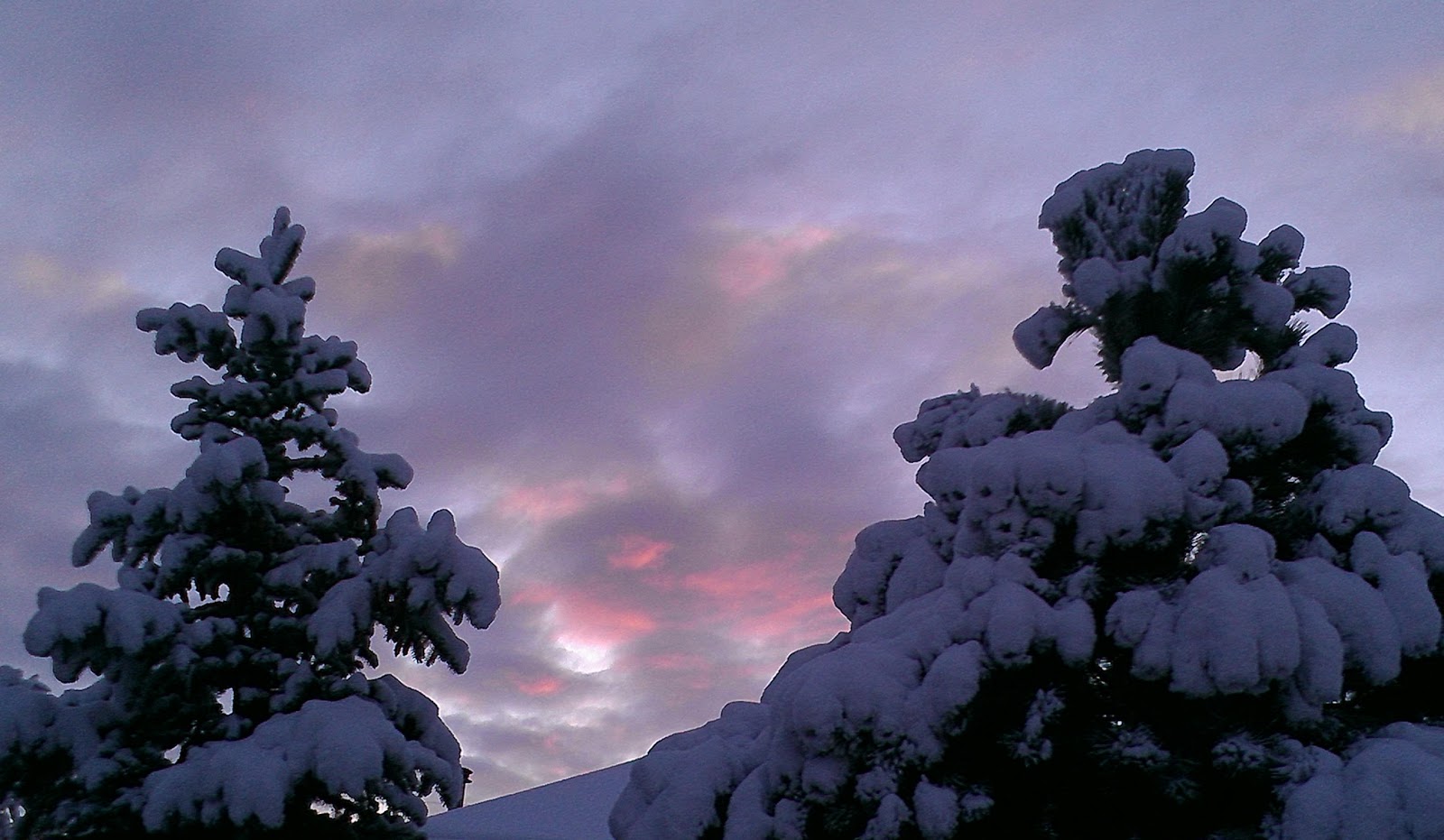
I was reminded of Obama's iconic logo as I stood on a hill near my house watching the sun rise. Today, mercifully, the election is over, hope has won, and the sun is shining for real, as you can see.


To the east ...


                           to the south ...


                 to the north ...


and to the west, the glorious west ...


welcome, sunrise.


Monday, November 5, 2012

Leonard Cohen, a thousand kisses deep


Saturday night, we went to hear Leonard Cohen in concert. I was about halfway excited and about equally wishing we weren’t going … an un-frantic end to the day sounded pretty nice. But we’d had tickets for months, and although we always see tickets as an opportunity and not an obligation, Cohen is getting up there in years, we both like his music and neither of us had ever seen him live, and it was right down the road. So off we went.

Little did we expect that it would be nearly four hours after the concert started before it ended. True, Cohen and his friends had initially left the stage about 10:30—already a longish concert. But they came back for an encore … and another … and another … and yet another. I usually think an encore is really just the tail end of the planned concert. But four of them?

My usual endurance level for concerts is right at two hours. By then, I’m ready for it to be over. I once sat through a delightfully timeless four-hour birthday concert for Pete Seeger in NYC, where my partner had taken me for my b-day. But that event featured many, many artists, lots of them personal favorites. The one last night, on the other hand, was virtually all one guy, with the help of his sidekicks. Actually, he featured all of his band members and back-up singers at various times. And well he should—they were all outstanding musicians. They were also a strikingly international group—Spain, England, Mexico, and Moldova, were represented (as well as the Republic of Texas.) Anyhow, they were great and he was amazing.

I’ve always appreciated Cohen’s music and his song-writing—how could you not like “Suzanne” and “Hallelujah” (the latter especially as sung by k.d.lang). But I had no idea I would be so entranced that I’d happily listen to four hours of his mellow, deep-voiced, often somber, almost always philosophical music. I really didn’t want it to end. Besides, watching him is almost as engaging as listening. He began many (most?) songs by falling to his knees, from which he rose effortlessly with nary a hand on the floor for a boost. Whether on his knees or standing, he virtually always sang with his head lowered and his shoulders rounded, his left hand cupping his mouth and the microphone. He wrapped his body around his music as if he were guarding it. My partner likened his posture to Kokopelli, and it fits.


I could say so much (did I mention it was four hours long?), but I want to talk about two things … two very different elements of this program that I found especially nice. The first was his frequent references to aging. He sang about aging in what seemed to me a really lovely way, not tragic or morose, not superficial or trivializing. Like you might describe an evening. His music seemed to comment on his aging as an interesting element of his life. Inevitable, present, sometimes getting in the way or disappointing, but never to be mourned or resisted. My partner thought he might be Buddhist, which would explain this attitude: death is simply part of the cycle of life, all things are impermanent, attachment causes suffering. Sure enough, I learned, he is a Buddhist monk. He is also a practicing Jew, and his music is full of Christian symbolism. Although that seems complicated, it also feels completely compatible with his deeply philosophical lyrics.

Back to aging ...

Several of his references to aging were sort of in passing—a line in one song about “this old man’s face,” another about “now I hurt in the places where I used to play.” But the song that really captured my attention was “A Thousand Kisses Deep,” which I had never listened to carefully before. I searched for the piece online and learned that it was initially published as a poem. He has performed it both as a song and in spoken-word form countless times over many years. And there may be as many versions as there have been performances. Folks who follow these things have explored the question of which is the “real” song and why he's created so many variations of it. But I figure a person can have as many versions as s/he wants of a song s/he wrote (and apparently keeps on writing). It's actually interesting to hear some of these—some are strikingly different from others, whereas some variations are rearrangements of lyrics seen in other versions. For a taste, you can read two very different sets of lyrics here and here. Better yet, you can listen to a fairly recent sung version of “A Thousand Kisses Deep” and also a recent spoken version. Then, if your curiosity is still curious, as mine was, finish up with an older spoken version (as a bonus, if you click on “show more” beneath this last video, you’ll see yet a third set of lyrics).

But the point I want to make is not about the fluidity of the lyrics but about the message this song carried, at least for me. Of course, I have no idea what Cohen actually meant to convey with this poem/song—and his meaning very likely changes along with the lyrics. But to me, at least on this particular evening and in the context of his other references to his aging, it sounded like a love song to life. Sung by a man who is growing old (78) and has had a rich, if not always smooth, life. By someone who regards aging as simply a reality. Someone who sees life as a lover with whom you speak gently and make love but to whom you don’t cling, as a lover whose passing is marked and whose departure is expected and even accepted—not sought, but also not resisted or dreaded. And if that doesn't sound Buddhist, I'm missing something.
    
If I were a psychologist for real, I might think that this is all projection—that I’m hearing in Cohen’s lyrics the song I’d like to (be able to) write to my life. But see what you think. Here are some of the lines that sound to me like an ode to life, recited from its waning years. These are excerpts from various versions of the song/poem. Most were in the version we heard the other night—not necessarily in this order. You can hear them all in his voice through the videos linked above.

Excerpts from (various versions of) “A Thousand Kisses Deep”
by Leonard Cohen

  
  My mirrored twin, my next of kin 
  I’d know you in my sleep
  And who but you would take me in
  A thousand kisses deep

  I’m just another snowman
  Standing in the rain and sleet
  Who loved you with his frozen love
  His second hand physique
  With all he is, and all he was
  A thousand kisses deep

  I hear their voices in the wine
  That sometimes did me seek
  The band is playing Auld Lang Syne
  But the heart will not retreat
  There's no forsaking what you love
  No existential leap
  As witnessed here in time and blood
  A thousand kisses deep

  The autumn moved across your skin
  Got something in my eye
  A light that doesn’t need to live
  And doesn’t need to die
  A riddle in the book of love
  Obscure and obsolete
  Until witnessed here in time and blood
  A thousand kisses deep


    The ponies run, the girls are young,
    The odds are there to beat.
    You win a while, and then it’s done –
    Your little winning streak.
    And summoned now to deal
    With your invincible defeat,
    You live your life as if it’s real,
    A thousand kisses deep.

    Don’t matter if the road is long
    Don’t matter if it’s steep
    Don’t matter if the moon goes out
    And the darkness is complete
    Don’t matter if we lose our way
    It’s written that we’ll meet
    At least that’s what I heard you say
    A thousand kisses deep

    We’ll that’s my story …
    … all the twisted pieces fit
    A thousand kisses deep

So that was my personal existential leap this weekend


And on a totally different topic …


Another thing I loved about the concert was the visual artistry of the lighting. We were sitting close enough to the stage that I was trying to catch some pictures of the concert. But soon, I felt like I was in a sunset-picture moment … you know, when each moment is more brilliant than the last, so you just keep snapping away. I gathered a slew of these pictures into a sort of rainbow so you can see how visually wonderful it was.


A shot of the screen almost directly above us


And then he left ... over and over, the stage still changing color. Sort of like the song.


Wednesday, October 31, 2012

“8” (The Play)


Save the date! There is a play coming to Boulder—for one night only—that you definitely want to see (if, that is, you’re near Boulder. For those who aren’t, you'll want to find it somewhere near you.) The play is called “8.” Mark your calendar: Thursday, December 6, Nomad Theater. Let me explain what this is and why you want to be there.

First, a bit of context. As you likely know, this is shaping up to be a landmark year for same-sex marriage. Not only did President Obama (finally) declare his support for marriage equality, but the topic of same-sex marriage will be on the ballot in four states next week (MD, ME, WA, WI). And, as if that weren't enough, it seems likely that during this year's session, the US Supreme Court will hear at least one of several same-sex marriage cases that are currently sitting in the Court’s “to do” pile. Depending on which case(s) they choose to hear and how they rule, things may change in a big way for LGBT people from this year forward.

So it’s a wonderful coincidence that just as LGBT rights are likely to take center stage in the Supreme Court, what could be called a “reality play” about those rights is coming to several community stages around the country. And Boulder is one of the locations chosen to see that play. (Actually, it’s no coincidence at all. It’s due to excellent planning by Out Boulder.) Here’s the back story:

As you all know, in 2008, California voters passed Proposition 8, which overturned an earlier state Supreme Court ruling legalizing same-sex marriage in that state. Between the initial Court ruling and the vote on Prop 8, thousands of California same-sex couples chose to marry. This created an especially stark contrast between the presence and absence of equal rights: some same-sex couples were legally married, and just down the block, other couples were forbidden from marrying.

Now, this was not—by far!—the first time that LGBT rights had lost at the ballot box. In fact, we have never won when marriage equality was put to a popular vote (although that might change this year). But this was California, the most populous state in the nation. California, the state known for leading the nation forward toward progressive social change. California, the home of San Francisco, the Castro, and Harvey Milk!

Not surprisingly, Proposition 8 was almost immediately challenged—in the streets and then in the courts. In addition to LGBT rights groups, other, very surprising people also stepped up. Chief among these was an “odd couple” from the highest ranks of the legal profession who uncharacteristically joined forces to challenge Proposition 8: Ted Olson, the attorney who represented George W. Bush in the Supreme Court case that installed Bush as President in 2000, and  David Boies, the attorney who represented Al Gore in that same case. Despite their diametrically opposed political views on most matters, they both agree that same-sex couples should have the same right to marriage that heterosexual couples have. So this improbable team is leading the legal challenge to Prop 8 in the courts—perhaps all the way to the US Supreme Court.

The case moved up the judicial hierarchy to US District Court. There, the original plan called for the trial to be videotaped and streamed live, but the broadcast was blocked by legal maneuvering. In response, a playwright by the name of Dustin Lance Black decided to find a way to make the transcript of the trial accessible to folks in the real world.

Which brings us back to Harvey Milk.

Dustin Lance Black is probably best known for having written the Oscar-winning screenplay for the movie “Milk,” which tells the story of Harvey Milk’s rise to political office and then his assassination. Not coincidentally, “Milk” opened just before the vote on Prop 8. So now, determined to bring the Prop 8 trial alive for people on the street, Black has written a “play” that is basically an artistic rendering of excerpts from the transcript of the US District Court trial. That’s the play called “8”. It opened to rave reviews in LA and New York, where the parts were read by a megastar cast including Kevin Bacon, George Clooney, Jamie Lee Curtis, Morgan Freedman, Brad Pitt, Martin Sheen, and others you’d know if I could remember them. I saw the play streamed live from LA in those opening days, and it is amazing, compelling, jaw-dropping. You can see clips (with parts read by those very stars) here.

And now, “8-The Play” is coming to selected community theaters around the country. Each performance is hosted by a local group, which chooses a cast from among local folks (heck, your friends might be in it!). The idea is to bring the story home to people who should have been able to watch the trial as it unfolded but were prevented from seeing it. Until now. 

And here’s the best part (drum roll), our own Out Boulder is one of the groups selected to host a reading of “8-The Play.” But there’s more. Not content with only staging the play, Out Boulder aims to create an opportunity for the community to really engage in this story. Especially since Colorado has a unique connection to Prop 8 that makes this trial particularly relevant to us. So they have organized a panel to follow the play that includes experts in a range of fields and a variety of perspectives—law, political organizing and activism, religion, psychology—and even an economist who testified in the Prop 8 case. To see what I mean, check out the outstanding panel line-up. As the kids say, awesome!

This is going to be a wonderful evening—a thought-provoking play followed by an informative and engaging panel discussion combined with audience participation. You really don’t want to miss this!

Tickets are on sale at the Out Boulder site (or click here to order now). Get ‘em early, as seating is limited, and the play will happen on this one night only.

So if you haven't done it already, mark your calendar: Thursday, December 8, 7:30, Nomad Theater. 

You’ll be ever so glad you went.


Monday, October 29, 2012

537 votes


I just saw an excellent political ad. I know that sounds like an oxymoron, especially after months of them. But this one was particularly compelling. Surfing the net a bit, I learned that this ad is called “537,” referring to the number of votes that decided the election in Florida—and thereby in the nation—in 2000. The year the US Supreme Court installed George W. Bush as president.

Watch this ad … and then, if you haven’t voted yet, do. Tell everyone you know to do the same. As the now-familiar poster says, “Your vote is your voice,” and every voice matters. Especially now.

Full disclosure, just in case my own preference in this matter isn’t clear: I tremble and whimper at the thought of a Romney presidency—for women, for poor folks, for immigrants, dreamers, and would-be citizens, for people of color, for old folks, for students needing or having loans, for folks with existing health problems, for folks who rely on Medicare and Medicaid, for LGBT folks, for the environment, for the role of the US in the world community, for the composition of the Supreme Court for years to come, and for a lot of other reasons. On the more affirmative side, although I have been disappointed in Obama’s first term in many ways, I have also been heartened by the steps he has taken, despite intractable resistance, and I’m hopeful that there is more to come.

If you are in that vanishingly small sliver of still-undecided voters, I’d be happy to help you decide.

In any case please, please vote.


Friday, October 26, 2012

Welcome winter (and the end of the election season)


First, the really fun (important) partWatch this short kick-ass, re-empowering reminder as we near the end of this nasty political season. I got this through a friend ... pass it on to yours at will. (Those of you who remember Lesley Gore will especially appreciate this.)
  

And then, the really lovely (cold) partViews of an early winter early morning:


You can hear the dry earth whispering ... "let it snow, let it snow, let it snow!" Sort of like the voters whispering ... "4 more years, 4 more years, 4 more years!"


Saturday, October 20, 2012

Indian summer


When we’re really lucky, one of the great weather pleasures of Colorado comes around this time of year. Often, after a brief interlude that looks a lot like winter, we return to this lovely, crisp, clear weather when the remaining fall leaves hang on for a few more days or weeks, the sky is bluer than blue, days are balmy and mornings and evenings are cool. And you wish it could last forever.


I grew up calling this “Indian Summer,” which seemes like a lovely name for a lovely time. But each time it comes around, I think about stories of the origin of the term, and I’m reminded of how our prejudices melt into our language.

Here are some of those tales about the roots of the term “Indian summer.” Some are simply descriptive: it’s said to come from the colors of the season—the reds, golds, and rusty colors that are often associated with Southwestern Indians, or the copper colored skin that distinguishes Indians from Europeans. But others aren’t as benign. Some writers have said that the term came from colonial days, when it referred to a period when lingering good weather allowed the Indians to renew their attacks on the European invaders. Others have suggested that it referred to the warm weather caused by fires set by raiding Indians. Some linguists have pointed out that “Indian” has often been used to mean “false” (as in “Indian giver” and “Indian burn”). So this “false summer,” one that follows a glimpse of winter and that will surely be followed by more, is referred to as Indian summer because it’s fake, it will be stolen away.

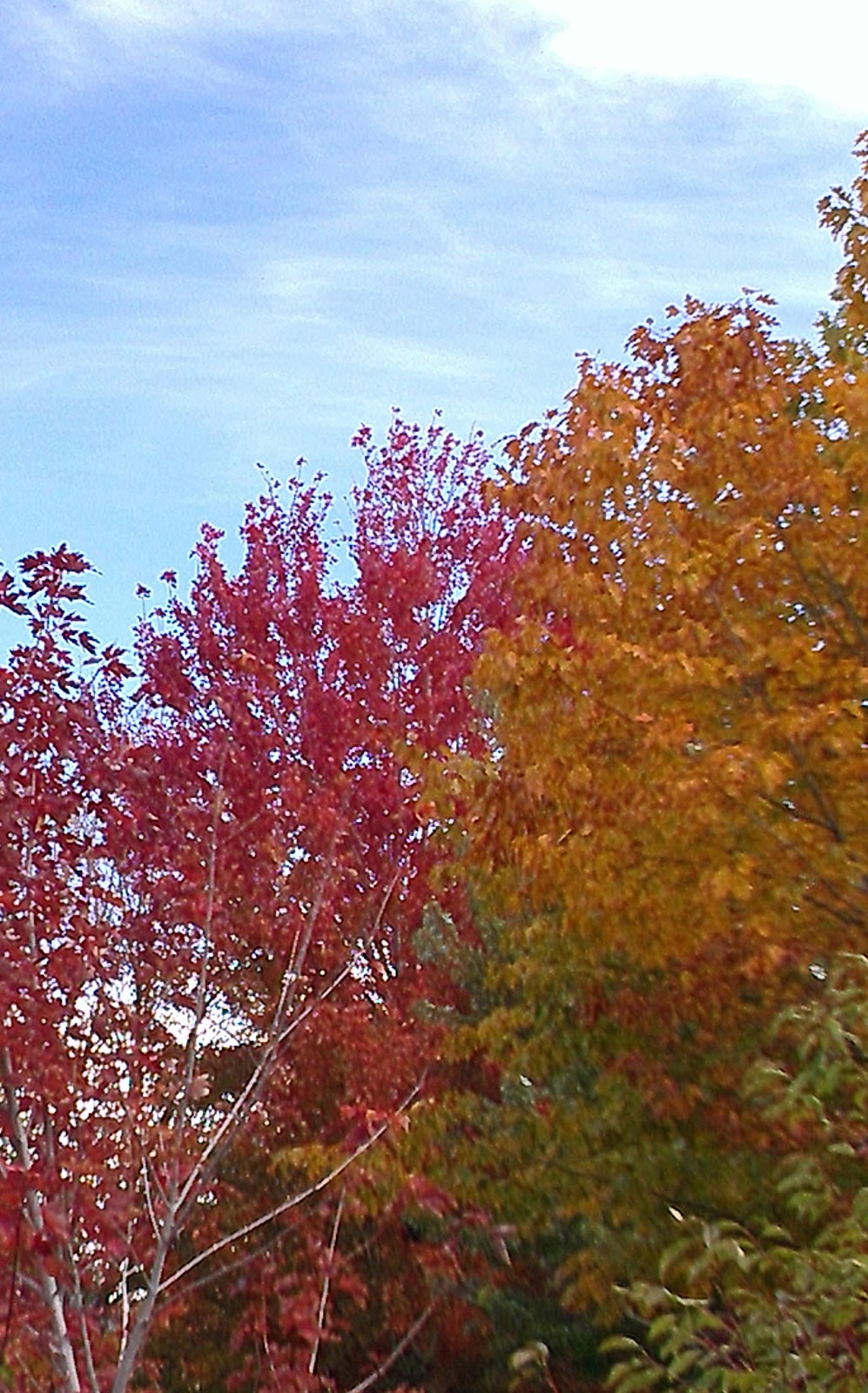
Likely, the term Indian summer has carried all these meanings at certain times and in certain places. And likely, I will continue to wonder (and worry) about this each time I have the pleasure of walking on a day like today. And accompanying my wondering, if I’m lucky, will be scenes like these.


Indian summer: the luscious, lovely, warm, crisp, colorful moment between fall and winter.


Thursday, October 18, 2012

Two things ...


… (both short) that you can hardly wait to read. 

In the past couple of days, I’ve come across two really great (and really different) ways to fill a bit of time between tasks or chores (or naps … whatever).

One is an excellent example of what I referred to in my last blog as “popular science.” It’s an article about the recent “Red Bull Stratos” project. You know, the guy who skydived from “the edge of space.” This is a discussion of the really interesting science that got left out of promotions for (and later stories about) that jump. Read it here.

And then, if you’re looking for some wit (as well as, IMHO, wisdom) in the midst of this insane political campaign, check out the recent blogs by Margaret and Helen. Some folks wonder if this blog is really written by two old women, lifelong friends who carp and bicker and educate, with a healthy dose of humor thrown in. Personally, I don’t have any trouble believing that’s just who writes the blog, but it doesn’t really matter. It’s great in any case. And I have a suspicion that the doubters are just envious. Anyway, check it out here.


Tuesday, October 16, 2012

Where are you from?


No, I mean really … not where do you live or even where did your grow up. Not even where did your parents come from, or your grandparents, or their grandparents. Maybe what I really mean is, Where are we from? And how did we get wherever we are?

My partner and I are about to participate in a scientific mega-project designed to answer these questions. The aim of the Genographic Project being conducted by National Geographic is to learn about the “human journey,” the migration patterns of Homo sapiens and their close evolutionary cousins over the past 200,000 years or so. Our cheek swabs will become micro-drops in a great genetic bucket that will teach scientists—and then us—tons about our human history. (This isn't the sort of analysis that provides information on disease risks and such. The point is not to understand health risks at the individual scale but to understand the emergence of the human family at the billions-of-people scale.)

The idea of tracing anyone’s ancestral history back tens of thousands of years seems like the stuff of science fiction. It wasn't too long ago that scientists figured out that we all came from one ancestral “Eve” who lived in east Africa and from whom all living humans descended. Eve, not “Adam,” is the identifiable ancestor of us all because mitochondrial DNA, which is transmitted maternally, provides the basis for tracing lineages. It’s the tool scientists use to study the evolutionary relationships among species and among populations within species.

So, anyhow, after analyzing our swabs, the good scientists at National Geographic will be able to tell us where our genes came from, how our ancestors migrated over time, which groups of modern humans and their hominid cousins added genetic information to our DNA. This information, in turn, will contribute to the process of mapping how humans have migrated and morphed over time.

You’re no doubt wondering about those “close cousins” I keep mentioning. There are two: the Neanderthals and the Denosivans. The Neanderthals (Homo neanderthalensis or Homo sapiens neanderthalensis) are a well-known relative—well enough known that we've managed to stereotype them as stupid and backward, although those stereotypes may be erroneous. The Neanderthals lived in Europe, and they apparently crossed paths with Homo sapiens, even occasionally interbreeding with them. On the other hand, Denosivans (Denosiva hominim) are a far newer story. Less is known about them, most of it from DNA taken from a fragment of a finger bone of a young girl, which was discovered in a cave in what is now Siberia. Genetic evidence shows that this group interacted and even interbred with both Neanderthals and modern humans. So now, most of us carry small traces of these early interactions—in other words, modern humans are part Neanderthal, part Denosivan, and part Homo sapiens. Maybe that will quiet those stereotypes a bit.

So why, you may ask, are we doing this? I’ll confess, it was at my instigation. Part of my enthusiasm about this project is sheer curiosity, part is my fascination with what used to be called “popular science” (i.e., science translated to a form that educates everyday folks). But apart from all that, I love the idea of participating in the creation of a story of us all, a genogram of the whole human species. Thinking about this project—and viewing this map of the “human journey”) brought to mind a comment often made by astronauts: From space, there are no borders. (In fact, a Mexican-American astronaut got some flak for using this observation to support comprehensive immigration reform). National borders are artificial, invented for purposes of dividing groups. The Genographic Project, on the other hand, seems to me reminiscent of the view from space. It erases borders, unites people.


"The Human Journey" from the National Geographic Genographic Project

This project reminded me of recent news stories about findings from genealogy, which have also expanded our view of our ancestry—or at least the ancestry of some famous folksat a more personal level. For instance, President Obama apparently has ancestral links to one of the earliest American slaves—through his (white) mother’s family. Michelle Obama had a white great-great-great grandfather. And then there’s former Secretary of State Madeleine Albright, whose family emigrated from Czechoslovakia around WWII, so she knows something about borders and their divisiveness—not to mention their impermanence. After being raised as a Catholic, she learned late in life that her parents had both been Jewish. 

How these stories dismantle tidy identity categories! How connected we all are—really! Like, in a very concrete sense. We’re even connected to the groups that we might regard as most distant and different from us. Stories like these make the categories we create and the borders we lay down seem not only artificial, but also cruel. I’m hearing John Lennon’s “Imagine” in my brain:

Imagine there's no countries
It isn't hard to do
Nothing to kill or die for
And no religion too
Imagine all the people living life in peace

You, you may say 
I'm a dreamer, but I'm not the only one
I hope some day you'll join us
And the world will be as one

OK, call me a dreamer, but I can’t help but think that greater awareness of how profoundly related we all are can only help. And if learning about our genographic connections as a species contributes to that awareness, I'm all for it.

I suppose it would be interesting to get a personal genealogy done, just to know in detail who my more immediate ancestors were. But for now, I’m content to know what I share with the Neanderthals and Denosivans. And how many miles my ancestors traveled, acting for all the world as if the landscape didn't actually need to be partitioned into nations.


Tuesday, October 9, 2012

School days

So, I’m taking two classes: Spanish and web design. Both were inspired by my partner’s asking whether I’d like to look at the continuing education catalog before she recycled it. “Nah,” I said (contemplating my stack of unread magazines). Then, feeling like it was something I really should want to look at, I said, “Yeah, I’ll take a look.” Once inside the catalog, I was hooked, and I started signing up.

Learning Spanish is an old wish. Living in Colorado, where the Spanish-speaking population is really large (large enough to have sparked an “English-only” law several years ago), it always seemed like it would be good to know Spanish. Then, over the years, I've become increasingly aware of our (i.e., the English-speaking world’s) arrogance in assuming that everyone else should know our language, but we aren't required to know theirs. Plus, I’m sort of a language buff. I fell in love with Latin in junior high, and I took more of it in high school, along with Russian. I was an exchange student in Germany in my senior year, and learned German the best way—by full and total immersion. In college, I took more German and Russian; I even revisited Russian during the year we lived in San Francisco, auditing a class at SFU.

But even with all that incentive, I've never learned Spanish. The final push (before the continuing ed catalog, that is) came from one of my volunteer gigs. A woman I work with through Boulder County’s Aging Services speaks Spanish as her first language. She also speaks excellent English … which means we spend all our time talking in my native language, and none in hers. At the senior center, where we spend most of our time, we encounter several other Spanish-speaking folks, many of whom my friend knows. I overhear their conversations, but I can’t participate; I can't even understand, except for an occasional word. So, I thought, here’s my chance. I can learn some Spanish in class and then have an opportunity to practice it for real. Perfect.

The only problem has been time (what a surprise!). I’d forgotten, sort of, how much concentrated effort goes into learning even the basics of a language—little things like vocabulary and basic grammar. I had been letting it slide, and then suddenly found myself mortified at the thought that I’d go to class and look ill prepared—which I was. So, I spent a lot of time over the weekend and on Monday (before the Monday evening class) studying. Which turned out (I remember now!) to be great fun. I loved the process of studying, loved feeling more knowledgeable, and went to class not dreading humiliation. Of course, Monday night’s class brought more new words, more new grammar, more studying ahead … I really do love being a student.

Then, the web design class. I signed up for this one mostly because it sounded like so much fun. I fiddle some with things computer-ish, and the slow mastery of new skills always gives me great pleasure. But I didn't actually have a website in mind that I wanted to design. It was really the process more than the goal that enticed me.

As it turned out, too few people signed up, so the class was cancelled. I was crestfallen. It actually spoiled my day. So, determined to do it somehow, I tracked down the teacher (whose name I had come across elsewhere, making it pretty easy to find her) and asked if she’d be willing to do a private tutorial for the same fee I’d have paid for the class. She agreed (yea!), and we set up a time. Then, she asked me to bring along some ideas and text (and even graphics) for the site I’d like to create. Now I was on the spot.

So I consulted with my partner, who has talked for a long time about needing a website, and she agreed to let me create one for her. She might decide to get a fancier one down the line, but this will be a start, I said … and if she hates it, I won’t put it on the Web. And she can always change it. So, she said OK, I worked up some text (with her help and feedback, of course. I’m not totally off in my own world here), and I met with my “tutor.” She proved to be a good teacher, and within a couple of hours, I had the basics to design a website. Maybe the best part was that I then got to spend hours and hours tinkering with it, re-writing, moving text, changing font, adding and deleting graphics, playing with color schemes, adding links … generally having a blast (see “lack of time to study Spanish,” above).

So now I have a load of homework and a beginning hint of a grasp of a minuscule corner of Spanish. A simple but content-rich website that promises to keep morphing and growing. And the great, grand pleasure of a return to studenthood.

I feel like a kid with a chocolate ice cream cone melting down my arm on a hot summer’s day. So much to enjoy, so little time.


Friday, October 5, 2012

S'no comment


Early morning . . .


Remember those 100° days we whimpered about?