Showing posts with label da Vinci. Show all posts

Wednesday, November 6, 2013

Leonardo's notebooks

About a year ago, there was an exhibit in Denver that featured the inventions of Leonardo da Vinci. I went three times. I (am) was so intrigued by this man’s mind—his amazing creativity across a whole range of domains, his ability to imagine contraptions into existence, his incredible powers of observation. I kept going back, and each time I saw new things.


Well, my partner spotted my fascination with all things Leonardo, so she just gifted me with a book called Leonardo’s Notebooks: Writing and Art of the Great Master. And today, wonder of wonders, I actually found myself with a spare hour to begin reading it. I was so enthralled by this book, I figured I needed to pass on my excitement—much as I did last year, dragging other folks to the exhibit.

So now I've entered a new phase of my enthusiasm about Leonardo. As you likely know, Leonardo da Vinci was a 15th century largely self-taught, multi-media genius. The exhibit I visited over and over last year featured his inventions, many of which anticipated (by centuries) later technological "innovations." I won’t dwell on those (although I could!) because I did that in an earlier blog. And then another one. I’ll just share a couple of pictures to remind you how grand this exhibit was.


At that exhibit, my partner and I also saw a movie that dealt more with da Vinci's historical context, his life, and his art (not that his inventions weren't "art"). He didn’t create many well-known paintings—although a couple are totally iconic:


But his drawings are legion. And, it turns out, so was his writing about art. Some of it borders on poetic ("And if you, O poet, tell a story with your pen, the painter with a brush can tell it more easily, with simpler completeness and less tedious to be understood"). Other parts border on pedantic ("The principle movements of the hand are 10; that is, forwards, backwards, to right and to left, in a circular motion, up or down, to close and to open, and to spread the fingers and to press them together").

This book consists almost entirely of da Vinci’s writings and drawings. The “Leonardo’s Notebooks” of the title refers to several loose collections of da Vinci’s drawing and writings—about 4,000 pages in all. The various “notebooks” are vaguely grouped by topic—but often cover multiple topics, even on a single page.

You may know that he wrote in “mirror writing.” This was not, it turns out, because he was paranoid about people being able to read what he wrote. Nor was it because he had some strange form of dyslexia or a neurological condition that made him see things backwards. Nope, it was because he was left-handed and had the same problem many left-handed folks report (or did back in the day of writing things by hand)—the ink gets smeared as the writer dragged her/his hand along “behind” the pen. But how amazing, whatever the reason! To be able to write both forward (which he also did) and backward. It’s a relatively small slice of his genius, but still …

The notes in this book demonstrate Leonardo’s amazing powers of observation—and his insistence that such careful observation is absolutely key to good art. For instance:

“It is indispensable to a painter to be thoroughly familiar with the limbs in all positions and actions of which they are capable … Then he will know the anatomy of the sinews, bones, muscles, and tendons so that, in their various movements and exertions, he may know which nerve or muscle is the cause of each movement and show those only as prominent and thickened, and not the others.”

To gain the knowledge necessary to be “thoroughly familiar” with all the bones and nerves and muscles and tendons and sinew, da Vinci, was a very careful student of anatomy. This is a bit surprising, as the Catholic Church, which pretty much ruled Europe at that time, forbade autopsies or dissection of any type. But apparently Leonardo had an “in” with the Pope and was allowed to perform autopsies to learn the details of human anatomy. And learn he did. In fact, he made many drawings of those muscles, bones, and sinew—and this precise understanding of the body’s parts allowed him to draw (and then paint) human figures that were remarkable for their anatomic precision and realistic movement. 

In fact, he seems to have been virtually obsessed with precision. Many of his writings go on in great detail about the precise proportions of various body parts to the total body size—and numerous drawings illustrate those principlesHere are some examples of his anatomical drawings, some of which will be familiar. These drawings are in the book, where they are easier to peruse in detail. The versions below are taken from google images, so pardon the variation in size and quality. Just to give you an idea ...


The same focused and detailed observation is also necessary, he argued, for drawing or painting non-human subjects. A few more (google) examples:


But it was not enough to observe the human figure carefully. Paintings often have multiple people, of course, so da Vinci also instructed painters about that:

“To compose [groups of figures] … when you have well learnt perspective and have by heart the parts and forms of objects, you must go about and constantly, as you go, observe, note, and consider the circumstances and behavior of men [sic] talking, quarreling, or laughing and fighting together; the action of the men themselves and the actions of by standers … And take note of them with slight strokes in a little book that you should always carry with you. And it should be of tinted paper, that it may bot ne rubbed out … Change the old [when it is full] for a new one. These things should … be preserved with great care, for the forms and positions of objects are so infinite that the memory is incapable of retaining them, wherefore keep these [sketches] as your guides and masters.” [Isn’t this amazing? What focus, what presence, what total single-minded attention to his work!]

And the details and realistic poses of the figures in his drawings are testimony to how seriously he took his own guidance.
   

Other sections of the book present his notes and drawings about perspective and visual perception, anatomy and physiology, botany and landscape, physical science and astronomy, architecture and city planning, sculpture and metalwork, inventions and experiments (the focus of last year’s exhibit), and assorted other topics ranging from poetry and art to war machines. The book closes with Leonardo’s contributions to the practical wisdom and philosophy of his day—a section I can hardly wait to read.

I’m not sure what my point is here. Partly, I was just so energized by spending some time playing in this man’s mind, and I wanted to share the excitement. Partly, I suppose, writing about this book seems like a bit of an antidote to my last blog, which may have seemed dour or fatalistic. In truth, delving into this book is exactly the sort of experience that keeps me surprised and delighted as life moves forward—a way of staying engaged rather than drifting.

So, maybe you can consider this blog simply an invitation. If you’d enjoy a glimpse into a remarkable mind—and I really mean a remarkable mind—track down this book. Just looking at the pictures will keep you happily amazed for some time. And then, if you have the time and interest to devote to Leonardo’s notes, I think you’ll find that you’ve met genius in black and white. And sometimes sepia.


Monday, January 14, 2013

Cultured


OK, I am now totally cultured. It took two days, two museums, the Hard Rock Café, a bookstore, a piano/flute concert, a slide show about the Civil Rights movement, and a stop at the hat shop … but the result is undeniable. I am cultured.

It’s rare for my partner and me to take a full day off from our various regular pursuits to play. But on Friday, that’s just what we did. She hadn’t seen the da Vinci exhibit, and although I had seen it twice before (the first time alone, chronicled here, and again with a friend who read my rave review here), I was totally game to go again. So after breakfast (our first trip to Snooze. Try it!), we spent Friday morning with Leonardo. This time, I got to see the whole movie, along with some short videos designed for our co-visitors, middle schoolers with ADHD. Their reactions were entertaining—especially their serious discomfort with full-screen shots of da Vinci’s famous “Vitruvian man” (Slip into your 11-year-old sensitivity and take a look). The movie was great. It added layers of historical information that gave an additional dimension to da Vinci’s inventions and his art. We wondered (leave it to two psychologists) whether his extraordinary perspective, his ability to draw physical renditions of ideas that others hadn't envisioned, had to do with some distinctive neurological characteristic. Guess we’ll never know, but it’s interesting to speculate.

Leonardo’s show was less than a block from the Hard Rock Café, so, given my partner’s enthusiasm about all things musical (remember the Rock and Roll Hall of Fame?), lunch just had to be there. In addition to the ceiling-to-floor rock ‘n’ roll memorabilia, the café had a continuous video of various rock performances. As good fortune would have it, the loop during our lunch included Bruce Springsteen singing my partner’s currently favorite-in-the-world song, “We Are Alive” from the Boss’s latest album. If you’re into message music, give a listen. (Think symbolically when you get to the part about worms and such.)

Then we were off to the Denver Museum of Nature and Science for the Pompeii exhibit. I had been keeping an eye on this, thinking I’d go for some Wednesday outing. But I’d failed to notice that it was about to close—like, it’s now gone (sorry). My partner was interested, too, so we braved the sinking temperatures and promise of snow to see the last days of Pompeii. The exhibit was really well done, drawing visitors into the daily lives of these folks before that morning in 79 A.D. when Vesuvius came alive and buried Pompeii (and several other towns) in ash and stones. Arguably the most powerful part of the exhibit was the casts of people and animals frozen in the positions they held when the ash and fumes overcame them. I’d seen pictures of these before, but being close the their life-sized reality was another experience entirely.

I was also stuck by some uncomfortable indications of the Roman class system on display in Pompeii. For example, I learned that wealthy folks sent their clothing to the “dry cleaner’s” to get it cleaned and bleached. The bleaching part was done by slaves, who walked on the clothing in pools of urine (collected from passersby and from animals), which served as a natural bleaching agent. And then there was the cast of one person who didn’t escape from the city (only about 1,000 of 20,000 citizens didn’t escape). You could tell he was a slave or a prisoner because the shackles were still on  his ankles. On the other hand, there was the apparent consciousness conveyed by a mosaic that hung in someone’s dining room. It represented death, portrayed as a skull, as the great equalizer that cancels out differences based on wealth and class. The mosaic depicts a level with a plumb line hanging from it; the weight is a skull. Hanging from the two arms of the level, balanced by death, are symbols of wealth and of poverty. I guess it is true that death comes to us all regardless of wealth. But it’s also true that the man with the shackles had no chance to escape, while most of Pompeii did. Well, for the time being. I guess they're all equally dead now.


Death as the great equalizer. Mosaic from a Pompeii home.

 After we left Pompeii, at once fascinated and stunned by the exhibit, we slopped through the falling snow to a coffee/reading break at the Tattered Cover, still Denver’s premier independent bookstore. That stop warmed and settled us enough to move on to our evening engagement: a piano / flute concert. Long ago, I wrote about a lovely evening spent with two women who have used their retirement to pursue their true callings: painting for one and music for the other. The music woman was the pianist at this concert, and she was joined by a flautist who also plays for the joy of it (neither of them was paid for this free concert). Their music was wonderful, and it seemed like it rounded out the day nicely, smoothing the ragged edges from Pompeii and taking me back (musically) to the time of Leonardo, where we started the day. Well, not all of the music was from that era, but the parallel is too good to pass up.

Finally, for a very different sort of cultural experience, on Saturday, we went to a presentation/discussion about a 1965 Civil Rights march in Birmingham. This march followed the famous “Bloody Sunday” confrontation when marchers first tried to walk from Selma to Montgomery and met with violence instead. The march we were there to hear about moved from the African-American section of Birmingham to the state capitol building in that city. A number of folks from Denver and Boulder joined the march, and this event featured their snapshots, turned into slides, and a narration preserved by the Carnegie Library in Boulder. Several folks who had walked that day were at this event, and they added their own recollections and reactions.

Seeing the pictures and hearing the participants’ commentary—in person and in archived form—gave an immediacy to the whole event that I think would have been missing if it had been just a lecture. Imagine marching through falling rain out of the muddy, unpaved streets and meager homes of the African-American section of town into the paved streets and well-heeled business district near the capitol. Imagine being “protected” by Alabama National Guardsmen with confederate flags on their uniforms. Imagine being unsure how (or whether) you could get from the end of the march back to the airport safely. Imagine your relief as you returned to Colorado just 24 hours later—aware, as one of the white marchers said, that your own fear ended when the plane you got home, whereas Birmingham’s Black residents lived with that fear all day, every day.

What more could you ask of a two-day experience of cultural immersion? Let’s see: painting, sketching, and invention wrapped in historical context; rock ‘n’ roll music, complete with nostalgic memorabilia; Roman elegance and death as the great equalizer; leisurely reading with good coffee; classical music performed in a soaring cathedral; and a trip back to a historical moment within my own lifetime.

Oh, yeah. I almost forgot the hat story. My partner has been craving a type of hat that I recently learned is called a “Donegal” hat. She found it between the Hard Rock Café and the Denver Museum of Nature and Science.

Just to cap off the day.


Thursday, December 27, 2012

Leonardo's genius


For my weekly Wednesday reminder that I’m retired, I went this week to the Leonardo da Vinci Machines Exhibition at the Denver Pavilions. For anyone who loves to tinker and who takes great pleasure in trying to figure out how things work, this exhibit is a total treat. It’s also a treat for anyone who is fascinated by genius—artistic, mechanical, scientific, architectural, across-the-board genius. For those with a historical/cultural bent, there’s a 45-minute movie about da Vinci's life and times. I was too fascinated with the inventions and ran out of time before seeing most of the movie. Good reason for a repeat trip.


Leonardo da Vinci is probably best known as an artist, but it was his inventive genius that caught my attention when my partner sent me the link to the exhibit website. There, I found pictures of all these models of his inventions. How could I not want to check these out? The models have been created from da Vinci’s drawings by artisans using the sorts of tools and materials that were available in his time. Apparently he left behind about 45,000 loose sheets of paper with notes (mostly in mirror writing), drawings, thoughts, experiments, and ideas for inventions. Some have been gathered into books, most of which are owned by museums around the world (except for the one that Bill Gates owns).

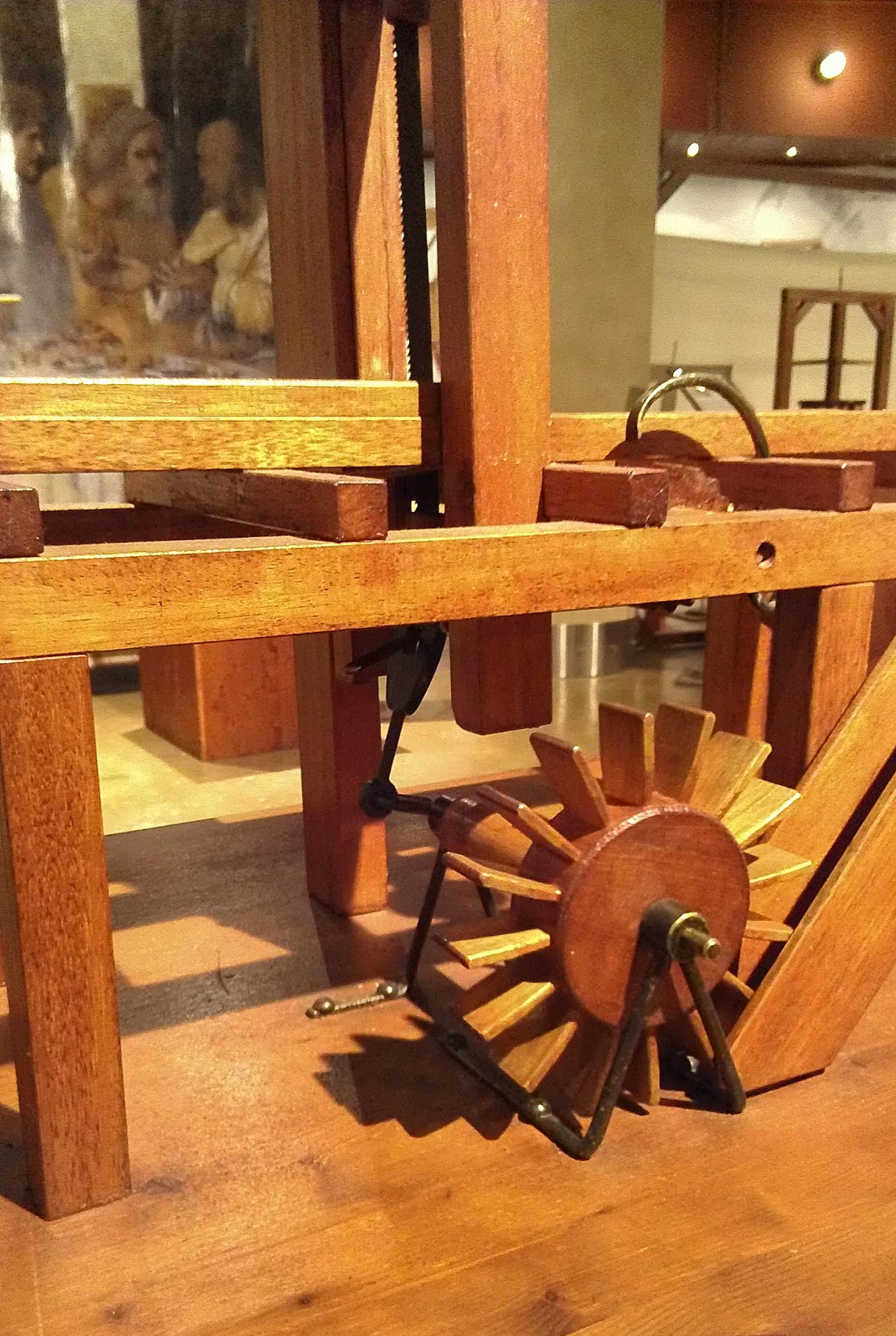
Waterwheel-driven saw - a gear-driven mechanism
moves the saw up and down and also slides the lumber forward


Ball bearings and spindles - freely moving parts reduced
friction, allowing one surface to move easily on another
("Lazy Susan" anyone?)

This description of da Vinci's study of chains
also shows the detail of his drawings

You can see about 60 models of his inventions at this exhibit, along with prints of several of his paintings (Mona Lisa, The Last Supper, and others). The inventions range from war machines through flying machines to a flood lamp and a 360° mirrored closet. Some have “Do not touch” signs, but others are interactive (those, of course, were my favorites. Tinker, tinker.) A large group of inventions and “studies” (where he played with ideas, tried out things without any particular end in mind) reflect da Vinci’s interest in mechanics. Turns out he either invented or pioneered in the development of such fundamental mechanisms as ball bearings, gears and gear-shifters, chains (which weren’t re-invented for another 300 years), differential gears for carts, pulleys, worm screws, fly wheels, hydraulic drills, systems to translate circular motion into linear motion, and a gadget that proved the impossibility of perpetual motion. Many of these were incorporated into his inventions: countless hoisting systems, modes of transportation (a horseless carriage, skis to walk on water, the bicycle, flying machines), gun turrets, robots, and on and on.


Differential gears allow a 2-wheeled cart to turn corners.
The design is basically like that used in cars today


This cart requires no horse. It moves using energy released
by the leaf springs, which is translated into forward motion
by the gears.


The things da Vinci invented depended partly on who his employer was. For instance, he lived in an era rife with wars—warring lords, warring fiefdoms, warring countries. So a lot of his inventions were designed as offensive or defensive weapons. These included an armored vehicle (forerunner of the tank), numerous devices to scale walls and to repel others trying to do the same, ship-borne mechanisms that tore apart enemy ships with a scythe, a multiple-cannon rotating turret for a ship, catapults, and more. The worst beast of all was a horse-drawn cart with four long blades that stretched out horizontally from the cart’s midline, rotating as the cart moved to cut a swath through any group gathered in the vicinity. Horrendous, though brilliant.  

The war monster - blades set rotating by the cart's motion
slash at anything in its path as horses pull it forward
Ship loaded with a scythe to tear apart enemy ships.


The original life preserver,
designed by da Vinci

Others inventions reflected his fascination with flight, including his famous “helicopter” and several designs for wings that a person might wear. Still others displayed his interest in water, including the first-ever design for the now-standard life preserver, another apparatus to allow a person to breathe while under water, and over-sized inflatable shoes to walk on water (with poles for balance). 

Some of his inventions have proven amazingly enduring, like the double-hulled ship, which kept the ship afloat even if a cannon ball ripped through its outer hull. It's now standard on commercial and military ships. Or the hinged ladder, which is now used on fire trucks. da Vinci designed it to scale enemy walls while being able to retract it at will if hot oil flew over the wall … but it’s still ingenious.


Double-hulled ship
Hinged, retractable ladder

And then there were his studies of anatomy, which he employed to magnificent ends in his painting and sculpture. (Reverting to his mechanistic frame of mind, he also designed a robot, clothed in a knight’s armor, based on his understanding of the mechanisms of the body.) Although one of his patrons was a Pope and the Catholic Church frowned on dissection, as an artist, da Vinci was given permission to participate in dissections, and his anatomical drawings are evidence of the care he took in this endeavor. Some of them are creepy (to me), but nonetheless fascinating. Unfortunately, I didn’t take any pictures of these … you’ll have to go see for yourself.

"The Last Supper" as a backdrop to gears and gizmos

The exhibit lasts through January 2013. Go see it – you’ll be glad you did!

Oh, and plan enough time to see the film …


Proof that perpetual motion is impossible.
You have to see it to understand (then please explain it to me)