Showing posts with label tinkering. Show all posts

Thursday, December 27, 2012

Leonardo's genius


For my weekly Wednesday reminder that I’m retired, I went this week to the Leonardo da Vinci Machines Exhibition at the Denver Pavilions. For anyone who loves to tinker and who takes great pleasure in trying to figure out how things work, this exhibit is a total treat. It’s also a treat for anyone who is fascinated by genius—artistic, mechanical, scientific, architectural, across-the-board genius. For those with a historical/cultural bent, there’s a 45-minute movie about da Vinci's life and times. I was too fascinated with the inventions and ran out of time before seeing most of the movie. Good reason for a repeat trip.


Leonardo da Vinci is probably best known as an artist, but it was his inventive genius that caught my attention when my partner sent me the link to the exhibit website. There, I found pictures of all these models of his inventions. How could I not want to check these out? The models have been created from da Vinci’s drawings by artisans using the sorts of tools and materials that were available in his time. Apparently he left behind about 45,000 loose sheets of paper with notes (mostly in mirror writing), drawings, thoughts, experiments, and ideas for inventions. Some have been gathered into books, most of which are owned by museums around the world (except for the one that Bill Gates owns).
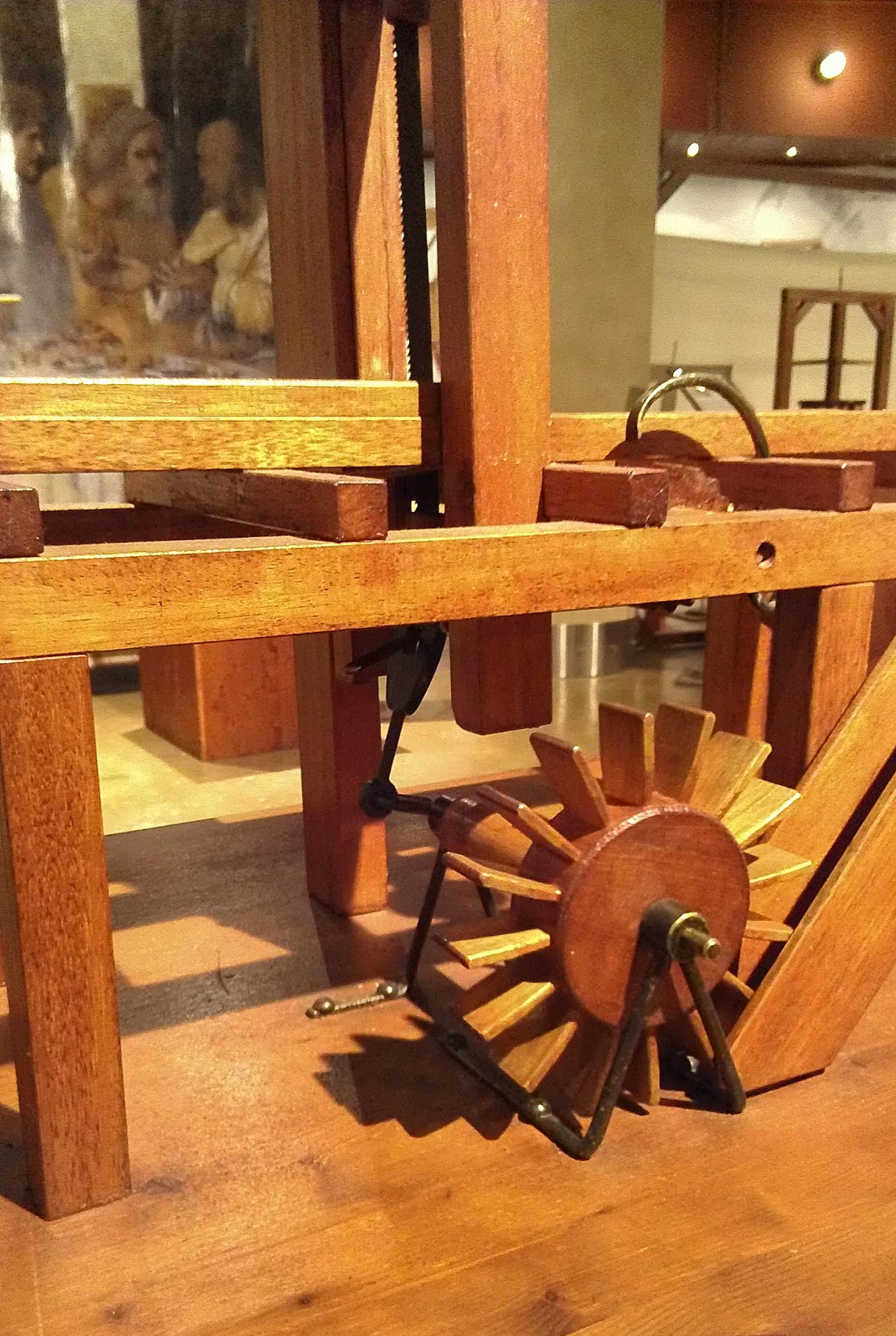
Waterwheel-driven saw - a gear-driven mechanism
moves the saw up and down and also slides the lumber forward


Ball bearings and spindles - freely moving parts reduced
friction, allowing one surface to move easily on another
("Lazy Susan" anyone?)

This description of da Vinci's study of chains
also shows the detail of his drawings

You can see about 60 models of his inventions at this exhibit, along with prints of several of his paintings (Mona Lisa, The Last Supper, and others). The inventions range from war machines through flying machines to a flood lamp and a 360° mirrored closet. Some have “Do not touch” signs, but others are interactive (those, of course, were my favorites. Tinker, tinker.) A large group of inventions and “studies” (where he played with ideas, tried out things without any particular end in mind) reflect da Vinci’s interest in mechanics. Turns out he either invented or pioneered in the development of such fundamental mechanisms as ball bearings, gears and gear-shifters, chains (which weren’t re-invented for another 300 years), differential gears for carts, pulleys, worm screws, fly wheels, hydraulic drills, systems to translate circular motion into linear motion, and a gadget that proved the impossibility of perpetual motion. Many of these were incorporated into his inventions: countless hoisting systems, modes of transportation (a horseless carriage, skis to walk on water, the bicycle, flying machines), gun turrets, robots, and on and on.


Differential gears allow a 2-wheeled cart to turn corners.
The design is basically like that used in cars today


This cart requires no horse. It moves using energy released
by the leaf springs, which is translated into forward motion
by the gears.


The things da Vinci invented depended partly on who his employer was. For instance, he lived in an era rife with wars—warring lords, warring fiefdoms, warring countries. So a lot of his inventions were designed as offensive or defensive weapons. These included an armored vehicle (forerunner of the tank), numerous devices to scale walls and to repel others trying to do the same, ship-borne mechanisms that tore apart enemy ships with a scythe, a multiple-cannon rotating turret for a ship, catapults, and more. The worst beast of all was a horse-drawn cart with four long blades that stretched out horizontally from the cart’s midline, rotating as the cart moved to cut a swath through any group gathered in the vicinity. Horrendous, though brilliant.  

The war monster - blades set rotating by the cart's motion
slash at anything in its path as horses pull it forward
Ship loaded with a scythe to tear apart enemy ships.


The original life preserver,
designed by da Vinci

Others inventions reflected his fascination with flight, including his famous “helicopter” and several designs for wings that a person might wear. Still others displayed his interest in water, including the first-ever design for the now-standard life preserver, another apparatus to allow a person to breathe while under water, and over-sized inflatable shoes to walk on water (with poles for balance). 

Some of his inventions have proven amazingly enduring, like the double-hulled ship, which kept the ship afloat even if a cannon ball ripped through its outer hull. It's now standard on commercial and military ships. Or the hinged ladder, which is now used on fire trucks. da Vinci designed it to scale enemy walls while being able to retract it at will if hot oil flew over the wall … but it’s still ingenious.


Double-hulled ship
Hinged, retractable ladder

And then there were his studies of anatomy, which he employed to magnificent ends in his painting and sculpture. (Reverting to his mechanistic frame of mind, he also designed a robot, clothed in a knight’s armor, based on his understanding of the mechanisms of the body.) Although one of his patrons was a Pope and the Catholic Church frowned on dissection, as an artist, da Vinci was given permission to participate in dissections, and his anatomical drawings are evidence of the care he took in this endeavor. Some of them are creepy (to me), but nonetheless fascinating. Unfortunately, I didn’t take any pictures of these … you’ll have to go see for yourself.

"The Last Supper" as a backdrop to gears and gizmos

The exhibit lasts through January 2013. Go see it – you’ll be glad you did!

Oh, and plan enough time to see the film …


Proof that perpetual motion is impossible.
You have to see it to understand (then please explain it to me)

Thursday, September 13, 2012

Tinkering

To tinker [ting'kәr] (intransitive verb): to fiddle with something in an attempt to fix, mend, or improve it, especially in an experimental or unskilled manner; to repair or invent. 

Wednesday, rainy Wednesday. My official, no excuses day to do something out of my ordinary routine. My dedication of Wednesday to adventures began as a promise to myself to notice that it’s summer. But I think I’ll continue on with it no matter what the season. Anyhow, this Wednesday’s steady rain made the hike I had planned seem less than a great idea. So (as I did before when the hot weather and forest fire smoke interfered with my outing), I headed off for the Museum of Nature and Science in Denver. Earlier in the summer, the place was full of kids on summer camp excursions, all in their matching t-shirts. This time, the place was much less crowded, mostly old folks like me along with a significant number of  parents with their trailing tots—the preschool kids with nowhere to play but indoors. I wondered to myself why these parents would choose to struggle with managing a passel of small children while pushing baby strollers through the museum. Then my partner pointed out that a horde of kids trapped indoors on a rainy day likely looked even more daunting than a day chasing them around the museum. At least the museum is spacious and airy, and it really does provide a ton of hands-on activities for kids.

So, anyway, you’re probably wondering what this story has to do with tinkering. It all began earlier in the week when I set out to resolve a problem with my largely perfect, maintenance-free garden, created by the marvelous garden lady. During watering time, one of the sprinklers (“misters” mounted on “risers,” if I have the terminology right), sprays a serious torrent against a garden-level window that provides sunlight  and weather news to my partner’s downstairs study. I worry that over time, that window will protest its daily drenching with a slow leak that trickles into said study. So, I decided to fashion some sort of fix that wouldn’t interfere with the spray to the garden but would block it to the window … without, of course, looking tacky or blocking the sunshine coming into the aforementioned study.

Well, my father’s legacy to me is the pleasure of tinkering. I don’t have many tools now (I used to have more, back in my youth), and I never had great skills, but I like it and I actually manage to “fix, mend, or improve” stuff occasionally. On rare occasions, I even “invent.” This was an invention moment. So, I plotted a plan. Between the garden and the window is a huge window well, which is surrounded by a wrought iron fence. So I wondered whether I could arrange something against or on that fence that would keep the spray confined to the flowerbed and spare the window. After scouting around the house and the garage for a while, I spotted the garbage can lid. Worth a try, said I. If it works in principle, I can try to conjure up a more lasting (less ugly) solution based on this. Sure enough (or, as my dad would say, “sure nuf”), it worked.

Off I went to the hardware store. Now, you should know that there have been times in my life when I was forbidden from entering hardware stores. A hardware store is to me like a bookstore to bookworms, a flea market to hoarders, or a candy store to most of us. However, since I was alone, there was no one to intervene, so off I went. Sometimes when I go to a hardware store, I know just what I’m looking for, which is halfway fun, the knowing. But the really fun times are when I’m not sure. I rarely ask for help—partly because I’m vain and arrogant (and I learned tinkering from my father, who would never ask for help!), partly because the adventure lies in exploring, figuring it out. The stuff I tinker with can come from any department in the hardware store. For this project, I cruised slowly through plumbing, electrical, hardware (nuts, bolts, brackets, hooks, etc.), lumber, gardening … and places in between.

I’ll spare you the many steps and many minutes and cut to the chase. With a bit of wandering, I found the perfect piece of Plexiglas, and was trying to figure out how to attach it. I told this hardware store guy my thoughts, said I was looking for something like a "U"-bracket—but, I told him, it might not know it’s a "U"-bracket. He understood precisely what I meant, and we headed off together on the hunt. Short version of a long walk: after while, he suggested a fix, which I agreed would be perfect, and I headed home with my stuff. To my delight, this gizmo will work—and, bonus, I can take it down any time I want to.

  
Curiosity being lowered by the "sky crane"
Now, back to the museum. I was reminded of this tinkering experience by a video I saw at the museum. I was looking forward to visiting the space section, and I was especially interested in seeing simulations of the landing of the new Mars rover, Curiosity. In case you don’t know how amazing this is: this particular rover came to rest on the surface of Mars after being lowered by a “sky crane.” This apparatus was actually a little rocket ship in its own right that descended toward the surface, holding Curiosity in its huge embrace. Then, some distance above the surface, it released the rover (while still hovering!) and lowered it slowly to the ground. This maneuver has never been tried before, and I really wanted to see it (at least in simulation). The folks at mission control called this “7 minutes of terror” because that’s how long it took from the time this complicated contraption reached the top of the Martian atmosphere until it landed safely (or not). Here’s a (slightly blurred) picture of the video showing this simulation. (As it turns out NASA has now released a great short video that you can see online. But I suspect it was more fun to see it surrounded by screaming kids in fake space suits.)

So here’s the tinkering part … This Curiosity simulation was just one segment in a series of stories about space exploration. One of those stories included a video interview with an astronaut on the International Space Station. He had this problem: when he tried to type on his laptop, the pressure of his fingers on the keys would make him float upward. NASA had installed foot straps where he could tuck in his toes to keep from floating, but that made his feet and ankles tired long before his work was done.

His wife, Earth-bound and never having experienced weightlessness, but no doubt hearing his tale of woe, came up with an idea. She thought to herself, “I could tinker (in the sense of ‘invent’) something to solve this problem. What I need is a trip to the hardware store.” (I’m certain she thought this, even though no one told me so. I recognize a fellow tinker when I hear about one.) And off she went. She came home with some very lightweight bungee cord, long enough to reach from the floor of the space station up between her typing husband’s feet, around his waist, and back to the floor. Since it only had to be strong enough to compensate for the pressure of his fingertips on the keyboard, this lightweight cord was plenty strong for the task.


Here’s a blurry screenshot of this guy tethered to the floor by a bungee cord the diameter of a thick spaghetti noodle. It's the white cord coming up between his feet and around behind his waist. He’s in his “quarters” here. It's small because you don’t need room for a horizontal bed in space. 


To sleep, he just slips into a bag bungeed loosely to the wall (seen in the almost equally blurry picture to the right).


What a fine finish to my Wednesday adventure at the museum! I got to see a simulation of Curiosity landing on Mars, and I learned about an astronaut’s wife who also belongs to the little-known and totally unofficial tinkering society. 

Maybe she’d like to get together for an adventure some Wednesday. I wonder if she could get us tickets for a trip to Mars.